Updates to this developing story will be posted daily for the duration of the June 6-8 Dead & Company residency.
War of The Wooks Part II
You can divide everyone in Las Vegas into two categories: you’re either a sucker or you’re not. This is a city that wants to eat you alive; it is designed to bait and then bankrupt suckers, or if you’re not a sucker, to coerce you into such a state of inebriation that it can bankrupt you anyway.
Hedonism tends to rule most environments, which is easy to condemn from the outside. But once you’re here, it seeps into your psyche. Maybe it’s the desert sun that has been beating down mercilessly in this June heat wave, forcing everybody to sweat out a bit of common sense along with the usual alcohol—or maybe it’s pure-and-simple cultural conditioning.
But sometimes I wonder if there really is something different about Las Vegas, if it might lie at some mystical desert intersection of strange and dangerous energies that turn even the most well-regulated travelers into wild pleasure-seekers.
I can see Sphere from the balcony of my hotel room; I stare at it when I smoke cigarettes, which is a perfect example of what I’m talking about here. I don’t smoke cigarettes, but something about this place compelled me to walk into a convenience store and buy a pack of Marlboro Golds.
Now I smoke them and stare at Sphere. It is the venue that brought Phish and Dead & Company into town, and along with them a group of wooks who have invaded the underground home of the Mole People. But was it really the bands or the music that brought these wooks here? Or was it some unknowable profligate energy beckoning them into Sin City?
What is undeniably true is that a situation, the implications of which nobody can guess, is currently unfolding beneath our feet—and things are only getting more complex.
After Shrieks & Whispers broke the story of the wooks occupying the tunnels, all hell broke loose across the scene. Reporters from JamBase, Relix, and the Grateful Dead subreddit all called me, begging to be put in touch with Sleeve—press officer for The Other Side of the Coin, the wook group occupying the Las Vegas tunnels. My editor had already instructed me to do my best to throw other journalists off the story—particularly anybody calling from wealthy concert promoter Peter Shapiro’s magazine, Relix—so I gave them all directions to Golden Corral in the hope that they would arrive and get distracted by the unlimited bourbon chicken.
The Hard News is that, to nobody’s surprise, resistance leader Zuri Zepeda won last night’s Prime Mole election against pacifist Grubby Busch. She and the Mole Person Liberation Front have assumed control over the scattered government-in-exile the Mole People established after the initial wook attack, and the dwindling territories it still controlled. When we left the tunnels, Mole People had just begun an attack on the wooks; one of our objectives for the day was to determine its impact.
Overnight, outside the tunnels, the insignificant citizen advocacy group that tipped me off to the conflict—Deadheads Advocating for the Freedom of Mole People—gained nearly a thousand new registered members across the world. Social media has already been flooded with DAFFOMP members condemning the ‘colonizing wooks’ and praising Zuri Zepeda and her ‘brave, heroic’ MPLF movement. Their central demand is that the Las Vegas Wastewater Authority intervene in the conflict in the tunnels.
My advisor and I revisited the Rio tunnel to talk to Sleeve, OSOC’s Press Officer, for a comment on Zepeda’s victory, the prior night’s attack, and the sudden rise of DAFFOMP.
“Firstly: the so-called ‘attack’ last night was, like, small beans. People at the front of the tunnels didn’t even realize that anything had happened. As far as the Prime Mole election,” he continued, “I really think it’s more sad than anything. I mean, we can make life so much better for the Mole People. This whole situation could be so much easier if they just, like, realized that. Now Vanguard says we might have to use even more force to keep them in line.”
I asked what he meant by ‘even more force.’
“I’m not sure. You’ll have to go to the press conference.”
In response to the sudden rise in publicity, Vanguard, head of OSOC, scheduled a press conference in the Caeser’s Palace-Rio tunnel junction.
Sleeve continued as we followed him down the tunnel toward the junction. “As for that, like, Deadhead advocacy group or whatever? The Other Side of the Coin’s official stance is that they’re nothing but a bunch of virtue-signalling hashtag activists. They want the Las Vegas Water Authority, some magic higher power, to intervene? So they can feel like they’ve contributed without having to get their hands dirty? Sounds pretty lame to me, man.” He led us deeper and deeper into the tunnels toward the end of OSOC territory.
Worth noting is that the Mole People themselves have been evasive on the issue of LVWA intervention; while I have been consistently unable to make contact with the MPLF, their Public Relations Offical, Grit Sumpump, told Relix that they “do not presently see the need” for the involvement of the Water Authority.
This creates a peculiar ideological tension between the MPLF and their staunchest supporters, DAFFOMP. Time will tell if the activist group changes its stance on the issue to align itself with the Mole People. I brought this up to Sleeve, who sounded ambivalent.
“The desire to, like, keep the LVWA out of this is the only thing we might have in common with the Mole People,” he said. “On another note, did you know that they started the wildfires in Canada last year? It’s true.”
The border between the wook-occupied segments of the tunnels and the shrinking areas still controlled by Mole People vacillates between pure chaos and disconcerting calm. Unlike traditional ground or aerial warfare, the ‘front’ of this underground conflict is only as wide as the tunnel. Mole People usually keep their distance from the border to stay safe, but when it becomes a place of conflict—when OSOC’s gradual advance down the tunnels meets MPLF members executing one of their attacks—the wook-Mole border is an utter pandemonium of piss-soaked cotton balls flying out of pipes, plywood spears soaring through the air, and smoke bombs bursting open with loud cracks.
These are the typical weapons of these battles; the confined, dark nature of the tunnels makes the use of firearms too dangerous: too deafeningly loud with too high a risk of ricochet. Realistically, only OSOC would be able to come up with the resources to arm a significant portion of its fighters, but doing so would introduce an asymmetry to the conflict that Sleeve said would “be awful for our image.”
So wooks and Mole People fight with other kinds of weaponry; baseball bats, shivs, slingshots, pillowcases filled with bars of soap. When no such battle is taking place, though, the border is unusually calm. The remains of a fight long over might litter the ground—broken smoke bomb canisters, dried-up pissballs, a crowbar, a half-eaten stick of jerky—but more often than not, OSOC sends sanitation wooks out to clean up these battlegrounds. As they proceed down the tunnel, they gradually light it up and hang their tapestries. All but the sturdiest Mole Person structures get taken down, and replaced by 5×8’ cinderblock buildings, each with two doors.
“We use cinder blocks so that, in the unlikely event of a flood through the tunnels, water will be able to flow through our buildings instead of destroying them,” Sleeve told us as we approached the border. “And they each have two doors because the fire marshall would be up our ass otherwise.”
These ‘wook huts’ are built on alternating sides of the tunnel, except in cases where absentminded construction wooks forget to switch sides and construct two on the same side of the tunnel in a row. In these instances, regulations state that two huts must be constructed on the opposite side to “preserve cosmic balance.”
Anytime the advance crosses a lateral drain—a pipe half the tunnel’s height in diameter that bisects the main passage—OSOC approves the construction of a ‘wook mansion,’ which includes a staircase leading up to the drain so that wooks could chill out and vibe in the drainpipe. Wook mansions are highly desired in the community, and living in one has become a status symbol in the tunnels. ‘Drainpipe parties’ have become the place for trustafarians—wooks who became independently wealthy, usually through an inheritance or a streak of good luck trading cryptocurrency—to gather away from poorer wooks.
I stopped to ask a trustafarian standing outside a wook mansion how he felt about the situation.
“Look, man,” he began, “the fact is that wooks just need someplace to be. I like this wook mansion and I want to live in it. I don’t really see any reason why I shouldn’t have what I want, you know? Life is too short, dude.”
A little further down the tunnel, one of the wooks living in a smaller hut—who asked to remain anonymous—stopped me and told me that the trustafarian I had been speaking to, Ritchie Rockstar, was “the single biggest asshole east of L.A.”
Wooks are allowed to live in huts in the tunnels for free, as long as they are willing to make some basic contributions like drugs or the occasional fast-food run. Ritchie Rockstar and other trustafarians, according to the Anonymous Wook, paid OSOC exorbitantly to live in the wook mansions.
“And that’s just one of their income streams,” the Anonymous Wook told me, whispering so that Sleeve—who had gotten into a debate with my advisor over the cheapest buffets in Vegas—couldn’t hear. “It goes higher than you think, that’s all I’ll say. Look into it.”
I promised to do so.
We arrived at the junction, which was packed with around a dozen journalists and the Channel 5 TV crew. The wooks had made progress down the long tunnel to the Mirage, but there was nothing but darkness at the end; would OSOC forces would make it all the way down or would the Mole People emerge at any moment to take their tunnels back?
I felt a hard slap on my back and turned to see two of my competitors in the world of journalism: Skye Ortak of Relix and Andy Gustafon of JamBase. My editor would surely want me to keep them at an arm’s length, especially after the stunt I pulled sending them to Golden Corral.
“How ya doin’, buddy?” Ortak asked, her voice dripping with vile.
“Oh, you know… pretty busy, what with all this going on,” I murmured
“I’m sure. Have you met Andy?”
“Only in passing,” I muttered, reaching out to shake his hand.
Gustafon refused my handshake. “Skye and I just met earlier today. Any guesses where?”
I shook my head.
“Golden fuckin’ Corral, that’s where. Somebody gave us some bad info.”
“Oh, dear. Well, at least you made it here on time.”
Ortak leaned in close to me. “I just want you to know,” she said through clenched teeth, “if you ever need anything… don’t fucking call me.”
My advisor, making note of the confrontation, finally stepped in. “Everything alright over here?” he asked.
“It’s fine,” I replied. “Meet my, uh, peers, Skye Ortak and Andy Gustafon. They’re journalists, too.”
Gustafon snorted. “Is that what you’re calling yourself now? How many readers does your little magazine have? Six?”
“Well,” I snapped, “if you include me, seven.”
My advisor stepped between me and the reporters. “Okay everybody, let’s just relax a little here, okay? I think the tense atmosphere might be rubbing off on us. We’re all here for the same reason, right?”
Ortak, smirking, leaned toward me again. “Here’s a tip for you: Mike Gordon is funneling money into OSOC. If you want to get the scoop, meet him at 2:30 at the Olive Garden on East Flamingo.”
She and Gustafon burst into laughter and walked away, casting deriding glances at me as they left.
“I can’t stand those highfalutin industry reporters,” I told my advisor. “They’re such bullies.”
“Don’t let it get to you,” he replied. “Anyway, we’re about to get started.”
Sleeve stood at a podium, and after everybody quieted down he gave a brief introduction to Vanguard, who emerged from the tunnel on the left and approached the podium.
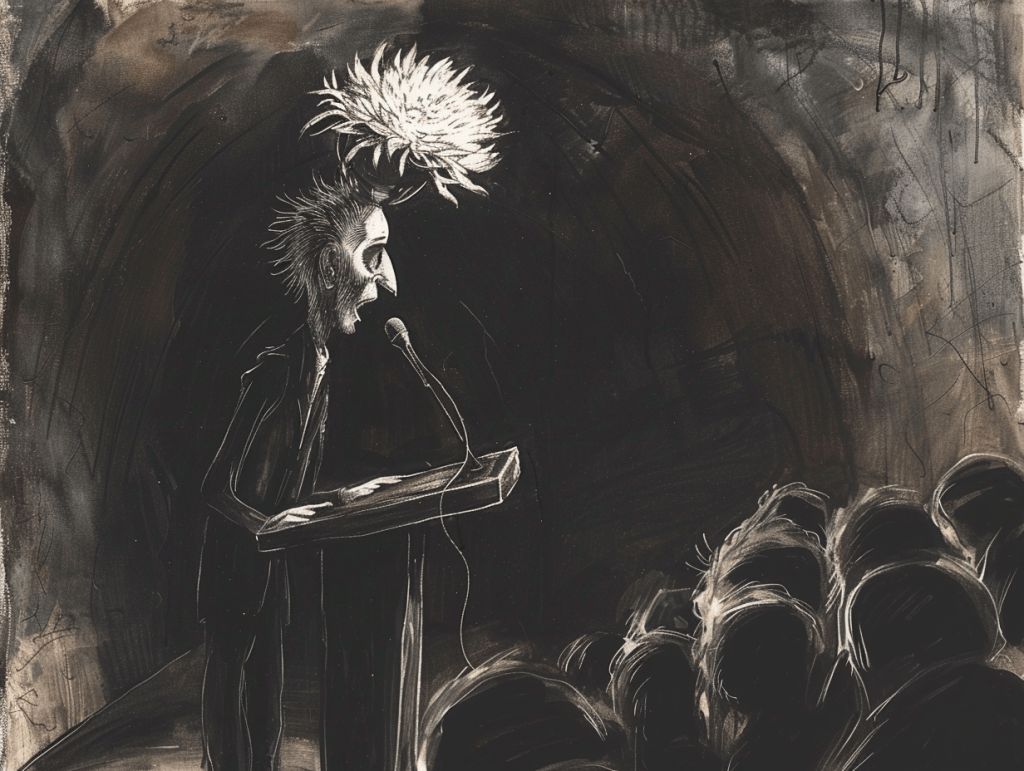
Vanguard is a tall, lanky wook, whose dark eyes hide a surprising intelligence and a strategic mind. A small flower pot with a single white chrysanthemum sat on top of his head, held in place by a nest of dreadlocks. He wore a traditional drug rug and a pair of baggy Thai fisherman’s pants.
“There’s this misconception,” he began, “that these tunnels belong to the Mole People, and that we here at The Other Side of the Coin are stealing from them. This could not be further from the truth. No, we are not from here, but it is our home now, and it will continue to be.
“Let me tell you this: I have slept in the bathroom of a McDonald’s. I have peed on the side of every highway between Dick’s and MSG. Was any of this allowed? Not necessarily. But I am a wook. And wooks are a different breed. Wooks aren’t afraid to turn the situation to their advantage, never. Wooks are strong. And wooks deserve safety. Make no mistake: the Mole People are the antagonists in these tunnels, not us.”
Sleeve stepped out, thanked Vanguard for his brief remarks, and opened the floor to questions.
The reporter from Channel 5 raised his hand. “Do you have any remarks on Deadheads Advocating for the Freedom of Mole People, the advocacy group that has been rising in popularity?”
“They may claim the best of intentions,” Vanguard said, “but if they truly wanted the Mole People to be free they would encourage them to stop resisting OSOC. And they would stop their foolish pleas for the Las Vegas Water Authority to step in and intervene.”
Skye Ortak’s hand shot into the air. “Do you care to comment on the MPLF attack on the border after the election last night?”
“The attack was insignificant.”
“Interesting that you say that,” Ortak said, “because Mole Person sources I’ve been in contact with said that the fight was pretty brutal, and that they significantly injured some of your fighters.”
“Only one question per reporter, please,” Vanguard declared sharply.
I frowned. Sleeve had shared the same sentiment—that last night’s MPLF attack was “small beans,” but Ortak seemed to have connections with Mole People who claimed otherwise. I cursed her internally; my editor would not be happy.
Andy Gustafon raised his hand next. “I’m sure you have heard about the rise of the Mole Person Liberation Front and their leader, Prime Mole Zuri Zepeda. How do you plan to approach this situation?”
“Firstly,” Vanguard began, “we do not recognize the validity of any Mole Person government in our territories. Opposition will be met with appropriate force. Secondly, Zepeda and her cronies are the ones who are making the tunnels unsafe for the average Mole Person, not us. Zepeda’s opponent, Grubby Busch, advocated for peace with wooks, and the fact that he received so little support is evidence of the Mole People’s unwillingness to make this easy.”
I raised my hand. “This operation can’t be cheap. Where does OSOC get the funding?”
Vanguard paused and turned to Sleeve, who leaned in toward the microphone. “We’re funded by, like, the community. We all sort of give.”
“There are rumors that wealthy wooks can contribute to OSOC for special privileges, like better housing. There are even rumors that funding is coming in from other sources. Can you comment on this?”
“We’re only accepting one question from each news outlet, but thank you,” Vanguard snapped.
“But your money must be coming from somewhere!” I said. “Why not be transparent? Isn’t that one of your values?”
“One question per reporter!” Vanguard announced aggressively. “If you keep up this behavior you will be barred from future press conferences. This is your only warning.”
I frowned and turned to my advisor. “What the hell is going on here?”
“I’m not sure,” he replied, “but I’m getting hungry.”
After the conference Vanguard retreated to his quarters in the Caesar’s Palace tunnel, my advisor and I walked back to the Rio tunnel to try to find the Anonymous Wook who had tipped me off about OSOC’s funding. I had obviously struck a nerve with Vanguard and Sleeve and I needed to dig deeper.
“What does he look like again?” my advisor asked, his head on a swivel.
“I don’t know,” I snapped, “he looks like a wook! Sort of unshowered, wearing lots of clashing patterns…”
“On a scale of one to ten, how did he smell?”
“I don’t know! Six?”
“One being the worst or ten being the worst?”
“I don’t know! What are you going to do, walk around smelling everybody here?”
“Do you have a better plan, Mr. Investigative Journalist? Do you think he’s just gonna tap you on the shoulder?”
I felt a tap on my shoulder and turned around to see the Anonymous Wook. I turned to give my advisor a Matt-Damon-how-do-you-like-them-apples look.
“Nice try at that press conference,” the Anonymous Wook said, “but you asked the wrong question.”
“How do you know about the press conference? It was barely ten minutes ago!”
He pulled a smartphone out of his pocket and showed me an article written by Andy Gustafon for JamBase titled ‘Uppity Small-Time Reporter Gets Put In Place by OSOC.’
“What the fuck? Why are you reading this trash?”
“I get all my news from JamBase,” he said.
“Well JamBase has a pretty tenuous relationship with the truth,” I muttered. I scrolled down the page and clicked on another article titled ‘Zelensky Visits Gaza.’ “Are you kidding me?” I asked.
“What? That’s the title of the newest Umphrey’s McGee album, and for your information, it’s really really good.”
“What? Why would they call their album… you know what? Forget about that. You obviously know something about OSOC’s funding. Spill the beans.”
“I can’t tell you because I don’t really, like, know that much. But I can put you in touch with somebody who can. Meet him in the leftmost bathroom on the top floor of the Sphere during setbreak tonight. The stall doors are all black, but there will be one green one. He’ll be behind the green door. He’ll respond to the password ‘penumbra.’”.
“Thanks,” I said, “but it’s just ‘Sphere.’ No definite article.”
My advisor and I fled the scene. With all the tension in the tunnels, I had nearly forgotten that I had originally gone to Las Vegas to have a good time and write a piece on Dead & Company.
We decided to visit the Tuscany Suites & Casino, where the officially sanctioned Shakedown Street was located. Shakedown Street is a signature element of any Dead & Company show; equal parts food truck rodeo, bootleg merch forum, and open-air drug market, the typical Shakedown is visited ritualistically by most devoted fans before—and sometimes after—every show.
This particular Shakedown was a drag on two accounts; firstly, due to the intolerable Las Vegas heat, vendors had to move to a second-floor indoor ballroom. Secondly, it was officially sanctioned. This meant that drug and alcohol sales were banned, which made this particular Shakedown Street uncharacteristically poorly attended.
DAFFOMP had set up a table. It was manned by three Deadheads in khaki shorts and tie-dye, and was surrounded by others with signs reading ‘FREEDOM FOR MOLE PEOPLE’ and ‘END WOOK COLONIZATION.’
Smitty Finkligan, a co-founder of DAFFOMP, sat in the middle of the table and was excited to meet me.
“I’ve been trying to advocate for this cause since I found out about the violent colonization movement in May, but I couldn’t muster up any support until the article you published! The anti-wook movement owes you, big time!”
“Woah there,” I said, “I appreciate the compliment, but as a journalist, I can’t accept it or I might be accused of taking a stance on the issue.”
Finkligan’s face hardened. “Don’t you realize that failing to take a stance makes you complicit with colonizers?”
I ignored the accusation and asked for a history of the movement.
DAFFOMP began during the third weekend in May, when Finkligan and his girlfriend, Patriciana Blinkspinkulli—both Vegas natives in their 20’s—attended the first set of Dead & Company shows at Sphere. They became aware of the conflict “through the grapevine.”
Finkligan and Blinkspinkulli both have family members who have lived in the tunnels; it had become an issue close to their hearts, and when they heard about OSOC’s invasion they felt deeply that they had to do something. The conflict didn’t get much attention until Shrieks & Whispers published my article, and immediately there was an outpour of support from all over the country.
“People see injustice in the world and they want to do something about it,” Blinkspinkulli said, “so they follow DAFFOMP’s social media pages and sign online petitions. Activism is so easy nowadays!”
I asked if DAFFOMP had any particular stances on the Mole Person government-in-exile, and Finkligan told me that Vanguard’s refusal to recognize the validity of a Mole Person state was tantamount to a war crime.
“And the new Prime Mole? Zuri Zepeda? She and the Mole Person Liberation Front get DAFFOMP’s full, unwavering support. The attack on the wooks last night was an act of heroism. In fact, I’ve actually been in contact with the MPLF’s financial director, and I’m proud to say that DAFFOMP has raised over five thousand dollars for their cause.”
I was surprised to hear this. “Are you ever afraid that OSOC will target you?”
“Sometimes I’m afraid, yeah,” he agreed, “but I just won’t skip out on a chance to do the right thing in front of a journalist—or even better, a TV reporter. Do you know Anderson Cooper? I think he’d be interested in this.” Finkligan handed me a pin that said ‘TELL LVWA TO MAKE THEM STOP.’ “This is what it’s all about,” he said. “The fact that the Las Vegas Water Authority hasn’t yet intervened is disgraceful. To take no action is to be complicit with colonizers.”
“But the MPLF told Relix today that they are against the intervention,” I pointed out. “How do you make sense of the disparity between your stance and theirs if they have your unwavering support?”
“Well, you know… that’s just what we think is the right thing,” Finkligan said, wavering a bit.
Blinkspinkulli interjected. “It’s a good stance because all you have to do is ask for a higher authority to fix the problem. It’s much easier that way.”
“Right,” Finkligan agreed, “and this way we can just condemn them for doing nothing, while we do basically nothing as well. And even if the MPLF disagrees, we’re still raising money for them. Which is the important thing, and why we have all this great merch!”
DAFFOMP was selling t-shirts with phrases like ‘Wook Ethnostate? No Ethnoway!’ ‘OSOC, Don’t You Come Around Here Anymore!’ and ‘Zepeda For President 2024.’ A Deadhead walked up to take a look at the merchandise and scowled.
“Jerry would be ashamed to see his fans supporting a violent militia,” he jeered.
“You think so?” Blinkspinkulli demanded, standing up, ready to argue, “you think Jerry would want his fans to sit passively by while there are atrocities going on?”
“Yeah,” the man replied, “that’s exactly what I think.”
“Well, why don’t you get the hell out of here?”
“Ok, I will.” He left, and Blinkspinkulli shook her head.
“People like him disgust me. They’re no better than Grubby Busch.”
Busch, as it turns out, receives just as much criticism as Vanguard and OSOC, if not more. DAFFOMP sees Busch, whose campaign slogan was ‘I believe the Mole Person and the wook can peacefully coexist’ as a traitor to his people and culture.
“How weak-minded must Grubby be to take this whole situation sitting down?” Flinkligan asked from his seat behind the DAFFOMP table. “I swear, if he won the election, I don’t think Mole People could survive.”
Blinkspinkulli agreed. “I hope he just fades quietly away. He’s bad news for Mole People.”
My advisor, who had headed straight for the grilled cheese sandwich vendor when we entered the ballroom, interrupted my interview. “This place fucking sucks,” he told me. “Let’s go.”
Due to a scheduling error involving vodka cocktails, several hours of total unconciousness and an In-N-Out burger, my advisor and I found ourselves running late to the show. We sprinted up the escaltor inside the venue and gradually made our way to our seats.
“What songs did we miss?” my advior asked one of our neighbors.
“Just New Minglewood Blues,” he replied.
My advior turned to me with a shrug. “Fuck that song.”
I nodded back vaguely. He had given me another of his mysterious pills, and I had gone temorarily nonverbal. Suddenly, the closing notes of Sugaree faded out: the set was over, and I had spent the entire time outside of regular human consiousness.
In a daze, I remembered that I had a job to do: locate the green door and the informant that the Anonymous Wook pointed me towards. I remembered his instructions: the leftmost bathroom on the top floor of Sphere. I shuffled dizzily out of the row, pulling my advisor by the arm behind me.
“Where am I?” he asked. “How do we get back to Barton Hall?”
“We’re still in Sphere,” I said. “We have to go to the bathroom and meet somebody.”
“I’m hungry, I need a beer.”
“Don’t you understand that we’re in the middle of something important here? We need to meet an informant!” I pulled him down the stairs and out into the alley linking the 400 sections. “He said the leftmost bathroom. Did he mean stage left or house left?” I asked.
“While you figure that out, I’m gonna go get a beer.”
“Jesus Christ! Fine! Do whatever the fuck you have to do!”
“I know you don’t like beer, so I’ll get you a margarita or something.”
I stormed off to stage left and got in line for the bathroom.
There is no place on earth quite like the men’s room during a jam band setbreak. It’s the breeding ground for the filthiest commentary around and the mecca for the most strung-out hippies who, having held their urine for over an hour, congregate for the communal ritual release of post-metabolic alcohol byproducts from the bladder—hundreds of gallons of water and acetate and urochrome splattering all over urinals, toilet seats, and floors to the soundtrack of crazed psychedelic laughter and drunken guffaws.
I eventually made it through the insanity into the bathroom and saw one stall that had been painted a vibrant green. I left the line and knocked on it, shouting the word “penumbra” as the Anonymous Wook had instructed.
Before I knew what was happening, the door opened and I had been pulled in. I stood there with a wook who claimed to be a high-ranking member of OSOC. To protect his anonymity, asked me not to share his name or any physical characteristics.
I asked what he knew about OSOC and its funding.
“We have three main sources,” he said. “First are the trustafarians who live in the tunnel. You already know about that. They make large donations and receive special privileges; wook mansions, early access to new research chemicals, things like that. Second is the Nitrous Mafia. We get a cut of their profits, and in exchange they use the tunnels as a storage space and a hideout. That’s top-secret; only the upper echelon knows about it. I can’t tell you about the third source, because I am one of the few people in the know. If that information gets out, they’ll know I leaked it.”
I asked for some kind of clue to point me in the right direction, but he refused. “If you think you’re on the right track,” he said, “you’re not. Look higher.” He told me that we could meet again after the next show—in a location I obviously cannot disclose—and that even though he could not share the third source of funding, he would be willing to confirm or deny any information I might come across.
In less than a minute I was out. My advisor was standing outside of the bathroom, and handed me a margherita in a promotional shaker cup. I shared the new inside scoop on the Nitrous Mafia.
“I’d just like to let you know,” he said, “that this new information will not make me rethink my decision to support them. I will still do whippets.”
By the second set I regained a loose grip on this mortal coil. I have heard, in other reviews, that when you enter Sphere you forget that you’re in Las Vegas and get lost in the music and whatnot.
All I can say in response is that I’d love some of whatever the person who wrote that was smoking, because I was almost painfully aware of the city I was in. Sphere is a venue of incredible decadance; just to travel there and attend a three-show run is an act of such immense indulgence that it is impossible to ever doubt that you’re in the one-and-only Las Vegas, the Glitter Gulch, the Marriage and Divorce Capital of the World.
Sphere could never exist anywhere else; there is no other place in the world that would accept a 360-foot glowing ball in the middle of the city as plausible and appropriate. It is a monument to spectacle; each song performed there at becomes an extravaganza of light and sound, entertainment distilled to it’s highest possible proof and distributed to the masses via a million LED lights.
A long, long, crazy, crazy night, indeed.
Outside of any Dead & Company show you will hear the Nitrous Mafia before you see them; the signature repetitive hissing of balloons filling up with laughing gas, the occasional pop, the cries of “ice cold whippets” and “three for twenty” are as ingrained into the scene as tie-dye or marijuanna. But now these cries have a different implication; each sale meant more money for OSOC, more oil to grease the war machine churning through the tunnels below us.
I have never seen my advisor move faster than he did as he left the venue and headed toward the whippets. I stood outside the venue and watch as he inhaled balloon after balloon, donating at least fifty or sixty dollars to OSOC.
The Bellagio casino floor: the music playing overhead blaring, the sounds of fake slots fake-rattling and fake-stoping click-click-click-click-click—images of bulls, samurai, pigs with toupees, snare drums, cigar butts, birdcages, broken aviator sunglasses, scotch tape, strawberry hard candies, chapstick, all flying down the screen at breakneck speed, landing in incomprehensible rows which determine the flow of money in and out of the possession of thousands of degenerate gamblers every second of every hour of every day of every year—no longer restrained by the physical limitations of how many bizarre and arbitrary images could fit on physical slot reels, fanatical gamemakers have developed insane idea after insane idea, each machine a new hallucination, a fresh veneer for the same old deceptions: an equation, a number generator, a theoretical payout percentage. Preprogrammed probabilities for any payline.
I sat before a dumpling-themed slot machine, endless repetitions of sashimi and shrip and coriander leaves and the number 8 flying down the screen. Suddenly, the caricature of an Asian woman—who lived in the machine, smiling as she watched me futilely pound the ‘spin’ button—threw dumplings onto my paylines. A red pepper appeared, and its magical essence flew into each dumpling before turning into a dumpling itself. I had no idea what the fuck was going on.
My winnings were $6.74. I turned to my advisor, who was seated next to me at another machine. “This machine is making me fucking stupid,” I tell him.
“Oh,” he responds, my comment not reaching him in the machine zone.
“I’m starting to slip. What was in that pill?”
“Oh,” he said again, glassy-eyed.
“I have to go.”
“Oh.”
I stumbled away, searching for solace, for some respite from this bright-light ordeal. All around me, insane algorithms fired unstoppably behind every slot machine screen; degenerates clung vainly to hopes of winning, pushing buttons and pulling skeuomorphic levers, determining outcomes with ever-worsening odds.
Everybody knows that the house has an edge sharp enough to slit their throat, but they persist nevertheless—holding on to the aspiration that This Time Could Be Different, that maybe, with the correct combination of their lucky machine, their lucky socks, and the sign of the cross, they might beat the odds and hit that victorious jackpot.
It was all becoming too much; I could sense too much dopamine being released too intermittently in too many minds—I had to get out, and fast.
I walked outside to see the grand Fountains of Bellagio, its nozzles gyrating like the Hips of Elvis, water blasting out in arcs, synchronized to Viva Las Vegas. The show is pre-programmed, just like the slots, just like Sphere setlists… what in this town is not pre-programmed? The war in the tunnels?
My internal musings were cut short as my attention was drawn to the fountain. Someone—and something—was standing in the eight-acre manmade body of water. A camel? Nay—a camelops! But they had been extinct since the Pleistocene, how could this be? And sitting atop this majestic beast was a heavy-set man in formal dress, his air of mysterious regality enhanced by his long beard—he had no mustache, but thick mutton chops and a beard that extended from his chin like that of the Luxor Sphinx.
I cried out to the man, and he turned to me. The camelops, as if by some telepathic understanding of its rider’s wish, walked through the shallow waters to where I stood, dumbfounded at this unexpected spectacle. The man looked down at me from his steed, waiting for me to initiate conversation.
“What in life is predetermined?” I asked. “What is preprogrammed and what remains in our power?”
The man chuckled and contemplated for a few moments. His voice emerged as a deep rumble, with the distinctive glottal stop of an early 19th-century Vermont accent. “Hearken unto me, my young friend, for too many in this day and age inquire after the wrong matters. Yet, thou hast posed the right question.”
After a long pause, I asked if he would be willing to clarify a bit. He dismounted his camelops, climbed out of the water, and placed a reassuring hand on my shoulder. “Nothing is foreordained,” he said, “for we all possess the gift of free will. Even the wayward gambler retains his agency. Though God, in His infinite wisdom, knows beforehand the choices we shall make, He does not wield that knowledge to our detriment.”
I shied away from the man, and his arm dropped to his side. “I didn’t realize you were, uh, one of those,” I said.
“What dost thou mean by ‘one of those’? Pray, clarify thy words.”
“You know. Religious.”
“Dost thou think that my faith precludes the enjoyment of life’s pleasures? Nay, for true religion enriches life with joy and fulfillment beyond measure.”
“Right. Anyway, I have to get going. Nice to meet you.” I turned around, eager to escape this proselytizing man that came from the fountain.
“Tarry a moment before thou depart! In days of yore, my people and I would traverse the valleys astride camelops such as this,” he pointed to the camelops, standing dumbly in the fountain, “long before the rise of these casinos and hotels. I have dozens of wives! Canst thou imagine the delight? Dozens of wives! Does that not sound like an adventure?”
“Oh, Christ. You’re a Mormon?”
“I have noted thy use of the Lord’s name in vain, yet I shall overlook it this once. Know this: I am not merely any follower of the faith—I am Brigham Young! And thou shalt hearken unto my preaching, or else!”
“Right. Well, it’s been real, Brigham, but I’m afraid a double vodka soda is calling my name and I’m going to have to hearken to that. But keep the faith and whatnot.” I started walking away a little more briskly.
“I caution thee earnestly—this is thy final opportunity to heed my words before I am compelled to act.” He snapped, and I heard his camelops emerge from the water, two-toed hooves meeting solid ground with intimidating force. I picked up my pace, trying to reassure myself that if I just ignored the man he’d leave me alone, just like any overenthusiastic panhandler.
“Thou art finished, foolish journalist. Prepare to be trampled beneath the hooves of my noble camelops,” Young shouted.
I broke into a sprint, not fully understanding what I’d done to provoke the second president of the Church of Jesus Christ of Latter-Day Saints. I made it all the way around the fountains to the strip, and headed North up Las Vegas Boulevard.
I could hear Young’s camelops picking up speed behind me; he caught up before I even reached the Eiffel Tower. In an attempt to escape, I dipped into the traffic, enduring the enraged honking of drivers. Can’t they see that I’m being pursued by a long-dead religious leader riding an extinct animal?
I turned around to see Young, not far behind me, splitting lanes between oncoming cars like a New York City bike messenger. I crossed the median, slipping in between palm trees, cars honking ruthlessly, and the pursuit was anticlimactically ended when a bus hit Young and his camelops outside Margaritaville.
I jumped over the pedestrian fence and collapsed by the bow of Jimmy Buffet’s sailboat. By the time I pulled myself together and emerged from the bushes, the camelops carcass lay dead and bleeding in the street, but Brigham Young was nowhere to be seen. I entered the restaurant, ordered a Last Mango in Paris, and wept quietly at the bar.
When I finished, I wandered East and entered the Flamingo. I sat at Bugsy’s, the bar on the casino floor, and tried to collect myself. A man in a blue-and-white checkered suit and a tie decorated with playing cards sat down next to me.
“Enjoying your time at Flamingo?” he asked me.
“If you must know, not really. I just got chased through traffic by Bringham Young.”
“Ah, Bringham… he’s a pest,” he said, pulling two cigars out of his suit pocket. “But you could make the argument that none of this would have been possible without the Mormons.”
“You could make that argument,” I said, accepting a cigar, “but I sure wouldn’t.”
He laughed. “I can’t stand the Mormons myself, but then again, I was raised a Jew.” He handed me a lighter.
“I was raised Catholic,” I said, lighting my cigar. “Sure as hell didn’t prepare me for any of this.”
“I’ve worked with a lot of Catholics. Italians, mostly.”
“What line of work?”
“You know. Money, violence, that sort of thing.”
I shied away. “What’s your name?”
“Bugsy. Bugsy Siegel.”
I sighed. The last thing I needed was another encounter with an aggressive historical figure. “Thanks for the cigar, Mr. Siegel, but I think I’m going to head out.”
“Woah woah woah, not so fast!” he exclaimed. “Stay a while! Play a few slots!”
“I’ll think about it,” I said, standing up and preparing to leave.
“Hey!” he shouted, opening his suit jacket to reveal a gun—an S&W Model 10—holstered in his belt. “If I tell you to stay a while, you stay a while. You understand?”
“You know what?” I snapped. “No! I don’t understand! You’re the second dead guy who has shown up in my life just in the past hour. I don’t deserve this.” I stormed away and broke into a sprint when he started shooting at me.
Normal people, I told myself, usually hallucinated unicorns or elves, not religious fundamentalists and mobsters. I resolved to check myself into a mental asylum when I got back from Vegas, which is probably a good idea for even the most stable of tourists.
Puffing on my cigar, I continued North up the strip and found myself, once again, at the Venetian. Not knowing why I returned or what I should do, I wandered into the Juliet Cocktail Room and ordered a Jack and water.
“Good choice, kid,” somebody sitting next to me said. I turned to see Frank Sinatra seated beside me, waving down the bartender. “Make it two,” he said.
“Well this is just fantastic,” I said. “What’s your problem gonna be? Are you gonna have Jilly Rizzo whack me for you? Where’s he hiding?”
“Why do defensive, pal?” Sinatra asked. “We’re here to relax!”
“Just twice on the way here I’ve been assaulted,” I complained. “Bugsy fucking Seigel tried to shoot me not twenty minutes ago.”
“Come on now. Bugsy’s not that bad a guy. Me and Tony Curtis really used to look up to the fella. None of this would be here without ol’ Bugsy!”
“You think that would be such a bad thing?”
He chuckled. “I wouldn’t want to live in a world without Vegas.” The bartender handed us our drinks, and Sinatra deliberately counted the five ice cubes in his glass. He pulled two out and threw them at the bartender. “I came here to drink, not skate!” he snapped.
“Listen, Frank. Do you know what’s going on right now underground? There’s a goddamn war down there. A world without Vegas would be a world without that war.”
Sinatra shot me a sympathetic look and put a hand on my shoulder. “Let me tell you something, kid. Me and my friends, we used to run this town, you know that? Before this whole place was here, this Venetian hotel, there was a different casino. The Sands. Ever hear of it?”
“Of course.”
“We played the Copa Room damn near every night—me and Sammy, Dean, and Qunicy. It was legendary, kid, and now it’s over. They knocked it down back in ‘96 to build this. And now there’s a big ol’ glowing ball next door. Point is, times change—life is like the seasons; after winter comes the spring. Whatever’s going on in this war ain’t as bad as some of the stuff I’ve seen, I’ll tell you that.”
I sighed into my drink. “Maybe you’re right. Thanks, Frank.”
“You got it, kid. Keep the faith.” He got up and left, and I immediately had a small stroke and blacked out.
When I regained consciousness the sun was coming up and I was walking back into the Bellagio. My advisor was sitting at a slot machine, exactly where I had left him.
“Were you in the bathroom?” he asked, still staring into the screen.
Updates to this developing story will be posted daily for the duration of the June 6-8 Dead & Company residency.

 Shrieks & Whispers
Leave a comment