Updates to this developing story will be posted daily for the duration of the June 6-8 Dead & Company residency.
War of the Wooks Part I
Note/warning to the reader: the Las Vegas venue is called ‘Sphere,’ not ‘The Sphere.’ MSG Entertainment owner James Dolan has stated that the use of the definite article (along with other prohibited actions like vaping or selling grilled cheese sandwiches) is grounds for removal and a fine of up to $250. Dolan says that implementing this fine should be an easy way to make up for the nearly $100 million dollar loss that The Sphere has been operating on since opening.
9676 B.C.E: Columbian mammoths and camelops live and die in areas now known as the Tule Springs fossil beds. Neon lights have not yet been invented.
7976 B.C.E: Native Americans inhabit what is now known as the Las Vegas Valley. Modern archeologists have discovered baskets and other artifacts, but no neon lights, because they had not yet been invented.
1829 C.E.: Spaniards pass through and name the area ‘Las Vegas,’ which translates to ‘the vegas.’ No sign of neon lights.
1855: Mormons unfortunately show up in Las Vegas, but don’t stick around. They did not bring any neon lights—not only because they would not be invented for another 55 years, but also because the Mormons were total prudes.
1905: The San Pedro, Los Angeles & Salt Lake Railroad is completed. Las Vegas is officially founded as a city because it is a major stop on this railroad, which would eventually be used to ship neon lights. The Golden Gate Hotel & Casino opens.
1910: Neon lights are finally invented, but don’t make it to Las Vegas for almost two decades. Just imagine what could have been! Gambling also becomes illegal in Nevada.
1928: Ethel Guenter installs the first neon lights in Las Vegas.
1931: The population of Las Vegas quintuples. Historians disagree on whether this population boom should be attributed to the jobs created by the construction of the Hoover Dam or to widespread interest in neon lights. According to research done by neon experts at the Neon Museum, there were at least three neon lights in Las Vegas by 1931. Gambling becomes legal again and Mafia crime lords begin opening casinos and showgirl theatres.
1937: The Hoover Dam begins producing electricity and fulfills its intended purpose of powering all the neon lights on Fremont Street.
1946: World War II finally ends, and to celebrate, Mafia boss Bugsy Siegel figures out a way to use his illegally obtained money to legitimately fund and open The Flamingo. Later on, the mob celebrates by brutally murdering him.
1951: Frank Sinatra performs his first gig in Las Vegas at the Desert Inn. The U.S. Atomic Energy Commission begins detonating atomic bombs in the nearby desert. Mushroom clouds visible from the strip become a tourist attraction. When asked about the potential dangers of nuclear radiation, AEC Chairman Gordon Dean says that “it couldn’t possibly be as unhealthy as all that neon, could it?”
1956: Elvis Presley (inventor of the peanut butter, banana, bacon, and quaalude sandwich) performs his first gig in Las Vegas.
1961: Ocean’s 11 is released, starring the Rat Pack. Historians have yet to determine who Peter Lawford is.
1970: Elvis’ career unexpectedly peaks during a performance of ‘Suspicious Minds’ at the International Hotel.
2018: Madison Square Garden Entertainment announces and begins construction of Sphere.
2023: Sphere opens with a residency by Bono and His Wet Blanket Boys, more commonly known as U2. The residency grosses over $244 million.
February 7, 2024: An anti-abortion activist climbs to the top of Sphere. Afterward, Senate majority leader Chuck Schumer (D-NY) tells AP that he is “finally starting to take the pro-life movement seriously.”
April 18, 2024: Cocomelon for Adult White Males, more commonly known as Phish, play four already-legendary shows at Sphere.
May 16, 2024: John Mayer’s Dead Forever Revival Jamboree, more commonly known as Dead & Company, begin a two-month twenty-five show residency at Sphere.
June 4, 2024: An Airbus A321 passenger lands at Harry Reid International Airport. A degenerate gambler, who was apparently saving the money he would have spent on deodorant for one spin on a slot machine at Ceaser’s, sits in the window seat. A hedge-fund type who spent the majority of the five-hour flight from Atlanta loudly talking on the phone about equitable subordination, accelerated share repurchases, and zones of insolvency sits in the aisle seat. An up-and-coming young journalist wearing stylish Ray-Ban glasses and a bucket hat sits between them. The seatbelt light turns off, and the journalist immediately stands and dumps his Jack and Diet Coke on the gambler. He steps on the businessman’s Bontoni loafers as he enters the aisle, tells both men to go fuck themselves, grabs his carry-on out of the overhead storage, and storms to the front of the plane, much to the protest of the flight attendants.
Yes, dear readers, that was me. Longtime Shrieks & Whispers fans may be shocked that I, on most occasions the very picture of professionalism and poise, could ever have lost my temper—but rest assured that I was not responsible for my actions at that point in time. Shortly after the flight took off I had texted my advisor, who was accompanying me on the trip but had been seated elsewhere, to complain about my unfortunate seatmates. He got up from his seat and slipped me a blue pill which he told me was a CBD supplement, and I gratefully swallowed it with my Diet Coke, which I crave insatiably anytime I’m above 30,000 feet.
In less than an hour, it became clear that he had mistakenly given me one of the black-market extended-release stimulants that he was notoriously fond of. I was more wired than a power strip in a freshman dorm, and it was no help that I had been downing Diet Coke like it was going out of style. I got up to use the bathroom—which was a grievous offense to the hedge-fund fella seated next to me—and spotted my advisor on the way to the back of the plane.
My advisor had been seated in between two young women; the one in the aisle seat had fallen asleep on his shoulder, and he was deep in conversation with the one in the window seat. I reached over the sleeping girl and tapped him aggressively on the top of his curly-haired head.
“Hey, dumbass!” I hissed, “You gave me the wrong fucking pill! What’s wrong with you?”
He and the girl looked up at me and giggled. “So that’s why Clementine fell asleep!” my advisor exclaimed.
“Clementine? Who the hell are these people?”
“That’s Clementine, and this is Climax. They’re dancers at the Peppermint Hippo! They’re on the way back from Atlanta where they were visiting—”
I buried my face in my hands and screamed, cutting him off.
“Are you okay?” Climax asked.
“Am I okay?” I replied, incredulous. “I’m sitting over there between Smeryakov and Gen Z Richard Roma, I’m hopped up on Coke and god-knows-what street drug, I mean, do you think I’m okay? Would you be okay?”
Climax looked concerned. “What’s he talking about?” she asked my advisor.
“Shhh,” he hushed, wrapping an arm around her, “it’s okay. He makes obscure references like that when he feels threatened. It’s his defense mechanism, it’s not about you.” She curled up next to him and he gave me a serious look. “You’re scaring her. I need you to leave.”
I threw up my hands. “I’m scaring her? Look, just give me the right pill, okay? Wake me up when we land.”
“There aren’t any more pills.”
“What? What are you talking about?”
“We took them all.”
“Are you fucking kidding me? The three of you took all the pills?”
“Yes.” There was an intense pause.
“Switch seats with me,” I demanded.
“I’m afraid I can’t do that.”
“This is your fault. Switch seats with me. I can’t sit over there with those people.”
“I’m going to call a stewardess.”
“Stewardess? The preferred term is ‘flight attendant.’ Who are you, Gene fucking Dornick?”
Climax curled up closer to him. “He’s doing it again,” she whispered.
“You need to leave,” my advisor said, “I’m serious.”
A flight attendant approached me. “Sir, I’m going to ask you to go back to your seat.”
I groaned. “Just let me use the bathroom,” I begged.
“Fine. But after that, you’re cut off.”
“Cut off? You can’t cut me off from Diet Coke!”
“Sir. Please cooperate.”
I stormed off to the bathroom. When I got back to my seat the smelly degenerate had fallen asleep. I waved down a different flight attendant and told her that the sleeping man had ordered a Jack and Diet Coke (or a JDC, as I’ve been told they call it in the biz), and to my surprise, she charged it to his account and delivered it.
Unfortunately, the eight additional JDCs that I ordered on his behalf did nothing to improve my mood. I tell this story to reiterate my original point: that due to the stimulant which I had unwittingly taken—and the alcohol I had consumed in a genuine good-faith attempt to reverse the effects of said stimulant—I was not responsible for the fact that I dumped a drink on a man I had been stealing from before I told him to go fuck himself. I do accept responsibility for saying it to the hedge-fund douchebag, though.
I am similarly not responsible for the fact that I had to be escorted by security off the plane and out of the airport.
I waited outside the airport for a half hour until my advisor showed up with Climax and Clementine, who had woken up and looked giddy. They each kissed him on the cheek before getting into a cab.
“They can get us a free table at the Peppermint Hippo,” he told me as he tried to lift me up from the prone position I had assumed on the concrete. “Any night we want, I’ll just text Climax to let her know.”
I groaned. “You got her number?”
He nodded.
“Will you tell her that I’m sorry I was so rude?”
He picked my hat up from the floor and placed it back on my head. “Of course I will,” he said.
Who exactly is my advisor, and what were we going to Las Vegas for?
It all started a few months ago when my editor called me into his office to give me a new assignment. He wanted me to travel to Vegas to cover one weekend of Dead & Company’s residency there, and to capture the unique vibe of the Entertainment Capital of the World while the world’s premier jam band was there.
“Las Vegas is the most hedonistic wasteland this side of Berlin,” he told me, “and Deadheads are some of the most shameless drug users in the world. We need to capture that, and put it in print. This will be the story that gives Shrieks & Whispers the legitimacy it deserves.”
“What do you mean ‘this side of Berlin?’ What side of Berlin are we even on now?” I asked.
“Shut the fuck up, nerd,” he said spitefully. “I’m talking about finally earning our place in the pantheon of respected news outlets.” My editor was perpetually trying to put the magazine “on the map.” It was an obsession for him; he almost fired me when he found out that Relix broke the story of Phish’s residency at Sphere.
“Okay,” I said, “so you’re sending me to Vegas to cover the music and the atmosphere.”
“Yes. But I’m not letting you go alone; I’m sending you with an advisor.”
“An advisor?” I asked, incredulous. “What do I need an advisor for?”
“Because you’re a fucking nerd, like I just said. Knowing you, you’ll spend so much time sitting in your hotel room re-writing run-on sentences that you won’t give yourself time to get out there and see what’s happening!”
I threw up my hands. “Why don’t you just have him write the article, then?”
“He’s not a writer. He’s a man of experience! A man of appetite and sensation-seeking!”
“Well, you’re going to have to tell him to seek sensation with somebody else. I don’t need an advisor.”
“Yes, you do. It’s non-negotiable. You’re going to partake in every activity he suggests—gambling, drinking, wandering. And you’re going to take every drug he offers you.”
I stood up in my chair. “Drugs?” I yelled incredulously. “You want me to take drugs? I’m a journalist, for fuck’s sake! I can’t impair my perception with drugs!”
“This conversation is over. Get out of my office.”
And so it came to be that I met my advisor in the Shrieks & Whispers office before heading to the airport. A true man of appetite, he forced us to stop at a McDonald’s to get a twenty-piece nugget on the way in, and once we passed security he bought two sausage-egg-and-cheese croissant sandwiches from Dunkin’ Donuts—one to satisfy his craving and one to enjoy.
As I watched him scarf down a breakfast sandwich in a few huge bites, I felt despair begin to creep in. Who was this maniac my editor assigned to advise me?
On our way into our hotel we passed a group of three people holding signs reading ‘Deadheads Advocating for the Freedom of Mole People’ and ‘END WOOK OCCUPATION NOW.’
“Who the hell are they?” I asked my advisor.
“I don’t know,” he replied, “but they look like a pain in the ass. Let’s keep our distance. You never know who could be a violent criminal in this town.”
Against his advice, I walked up and took a flyer. Printed on cheap paper, it was covered in almost nonsensical scrawl about wooks attacking Mole People living underground.
“Maybe they’re fundamentalist religious freaks,” my advisor theorized. “I think you made a mistake approaching them. You don’t want to get involved in their scam.”
“You’re probably right,” I said, crumpling the paper and tossing it in a trash can. Still, I thought there might be something substantial in what they were saying.
When we checked into our room, my advisor immediately called room service for ice and a tray of Italian sausages. “It’s important to always get ice as soon as you arrive at a hotel,” he said.
“And sausages?”
“Not always, but I’m hungry.”
Despite everything, I couldn’t get the protesters we had seen outside—Deadheads Advocating for the Freedom of Mole People—out of my head, so I made a call to a documentary journalist who had covered the Mole People before. He reached out to some Mole People on my behalf, and when he called back he had some concerning news.
He didn’t have too many details, but apparently a large group of wooks had moved into the tunnel and had embroiled themselves in a bitter conflict with the indigenous Mole People. Realizing that I was in over my head, I called my editor to fill him in so that he could send a war correspondent to cover this breaking news while I focused on Dead & Company.
“We don’t have a war correspondent on the payroll,” he snapped. “You’re going to have to cover this one yourself.”
I was incredulous. “This isn’t my beat!” I shouted. “Who do you think I am, Marguerite fucking Higgins?”
“Stop doing that thing with the names!”
“Call a more capable news organization, then! Like the Washington Post or Buzzfeed.”
“Absolutely not. Shrieks & Whipsers is going to break this story.”
“What about the Babylon Bee? This seems up their alley.”
“I swear to god if another outlet gets a hold of this story before we break it I’ll kill you. If Shapiro and Relix get a hold of this first you will be dead, do you understand?” He was referring the popular jam band magazine Relix and its owner, powerful concert promoter Peter Shapiro. “This will give us the credibility we desperately need. You’re covering this. End of discussion.” He hung up.
I had been sent to Las Vegas to absorb and recount the culture around a city and a jam band; to experience the joy of those around me and to put it into words in a way that only I can—not to chronicle some hellish underground conflict. In a fit of frustration, I shrieked aloud.
“What the hell is going on?” my advisor said, running into the room.
“We’ve got a new assignment,” I moaned, “underground.”
“No! Not the people in the tunnels that that kooks at the airport were talking about?”
I nearly began crying. “Yes… we have to go to the tunnels.”
My editor soon reached out to my advisor to provide more specific instructions; he made it very clear that were were still to capture in writing the essence of Las Vegas and Dead & Company’s residency, all on top of covering the war.
My advisor argued, rightly, that there was no feasible way that we could get everything in; the shows, the debauchery, and the conflict, but my editor stood firm. He was determined to make Shrieks & Whispers the best source of news for the conflict without compromising the “hedonist angle” that he had been dead-set on before.
Unable to change his mind, my advisor and I resigned ourselves to a long few days and set out for the tunnels.
For the uninitiated, a wook is a nearly-rabid jam band fan whose life revolves around attending concerts, using recreational drugs, and asking everybody around them for free things—concert tickets, drugs, food, places to sleep, or any other supplies their parsimounious lifestyles require. All this intemperace comes at the cost of personal hygiene and general levelheadedness, and my advisor and I, well-aware of the ways of wooks, were left unsure of what to expect from our new investigation.
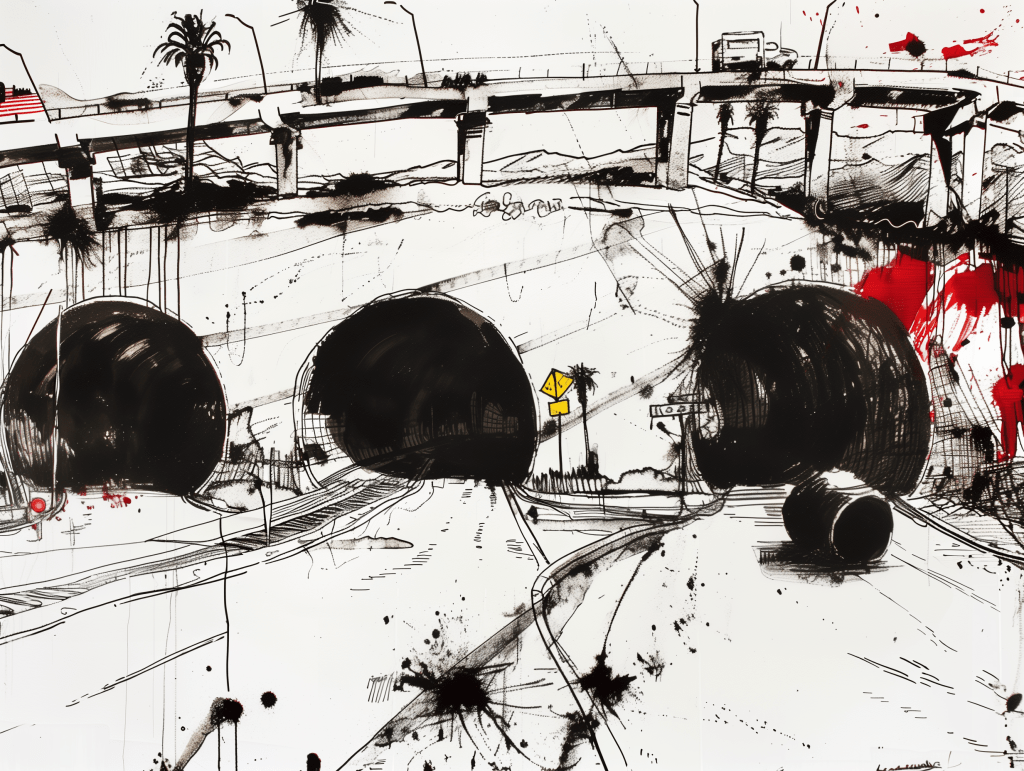
After an Uber dropped us off on Dean Martin Drive near the Flamingo Road overpass, we hopped a small metal fence and scrambled down the gravel decline. Rio Hotel & Casino loomed before us in all its red and blue glory. Penn & Teller, the Bad Boys of Magic, stared down at us from the huge advertisement that covered the building’s Eastern side. Penn was uncharacteristically silent.
Around a dozen Pontiac Azteks and Grand Ams were parked in a semicircle around the tunnel entrance. This particular tunnel, which I learned was the main outpost for wooks, led to a junction with the Caesar’s Palace tunnel. Further on, like the bottom of the letter ‘Y,’ another long tunnel led to the Mirage.
There was nobody to be seen at the entrance, but I had been warned that the wooks would treat outsiders with aggression, so I knew that we ought to act with an abundance of caution.
“Run up to the entrance and see if anybody’s hiding,” I told my advisor.
“Why me?”
“I’m the journalist here. If they kill you, I’ll still be alive to tell your story, but if they kill me, then what?”
“Fine.” He took a breath and charged toward the tunnel entrance. As soon as he entered the Pontiac perimeter, he was pelted from every angle by small, moist projectiles. He collapsed and began to shriek wildly. Two wooks toting pieces of PVC pipes that they had used as blowguns emerged from the darkness, and more emerged from behind the cars, where they had not been visible previously. I stayed back, not sure yet if it was safe to advance.
My advisor was incapacitated and nearly inconsolable. “Stop! Help! Don’t hurt me!”
A wook squatted near him and took a good look at his face and outfit. “He’s just a civvie,” he said to the other wooks.
“Out of your element, huh, little buddy?” another taunted.
“No!” my advisor screamed, “I’m a journalist! You can’t hurt me!”
The wooks all took a step back, a few cursing quietly to themselves.
“Oh. Well, sorry for the misunderstanding, man. We hold the ethical responsibility to protect journalists in combat zones as, like, the highest priority. Unlike the Mole People.”
“You do?”
“Of course we do, dude. Sorry about the pissballs. Not gonna happen again.”
“Pissballs?”
“Cotton balls we soak in piss. But you probably want to talk to our Press Officer, he’ll be happy to explain everything.”
At this point, I approached the tunnel entrance with my hands up. “I’m a journalist too!” I shouted. “A journalist of high regard! I would like to speak to your Press Officer as well!”
“By all means!” the wook replied. “Total transparency to the press is, you know, one of our core values. That’s not something you’ll hear from any Mole Person.” Flanked by the other wooks, we entered the tunnels.
We walked in, and the tunnels looked almost nothing like they had in documentaries I had seen; wook engineers had installed fluorescent lights and interior designers had hung tapestries over the grimy cement walls, covering up the indecipherable graffiti.
We stopped at the Press Officer’s office, which was constructed out of plywood and milk crates. Our wook guide knocked on an unhinged door, and another jaundiced wook with thick dreads tied together at the crown of his head pushed it aside.
“Oh… hello there. Who are these people?” He asked the other wook.
“They’re journalists. I told them that they could come see you.”
“Journalists!” he perked up and adjusted his pin-covered vest. “I’m the Press Officer, Sleeve. Take a seat.” he gestured toward a plastic picnic table. “Sorry for the conditions around here… we’re working on some upgrades.”
“Not a problem,” I said as I sat down with my advisor. “How much of this tunnel have you occupied?”
Sleeve chuckled. “Well, we don’t like that term very much, we prefer ‘made liveable.’ But, like, a half mile of this tunnel, specifically. That’s where it intersects with another tunnel that has a separate entrance, and we made that one liveable too.”
“And what’s beyond the regions you… made liveable?”
“Just a dangerous wasteland, man. That’s where the Mole People live, at least for now. Every day we get a little further down; that tunnel goes to the Mirage.”
I fished a recorder out of my pocket and handed it to my advisor. “You need to go there. Make contact with the Mole People, record everything and get back to me—”
“Hey, man,” Sleeve interrupted, “I wouldn’t do that if I were you. I mean, we respect journalists and won’t do anything to stop you, but Mole People are known to kill and eat their young. Just imagine what they’d do to you.”
I ignored him. “You’re a war correspondent now,” I told my advisor, “you have to do this.”
He looked uneasy. “I don’t know, I’m not sure if it’s safe.”
“It’s not.” Sleeve said. “Mole People are dangerous terrorists. We recently uncovered evidence that they were responsible for the collapse of the Francis Scott Key bridge.”
“Be that as it may, it’s essential for our coverage that you go in,” I insisted.
Looking very conflicted, my advisor got up and left, swearing to himself.
“I don’t mean to be a drag, man,” Sleeve said, “but your friend is definitely going to be tortured and killed as part of an occult ritual. Mole People love to do that.”
“I’m willing to take that risk. Tell me about… all this.”
The extremist wook organization that is currently occupying the Las Vegas tunnels is called The Other Side of the Coin, a reference to an aphorism from wook philosopher Alan Watts: “Something and nothing are two sides of the same coin. The positive and the negative; the something and the nothing go together.”
OSOC’s stated purpose is to create and defend a wook ethnostate by any means necessary. These wooks are willing to go to extreme lengths to see their goal realized, even resorting to violence; in their view, the fact that they operate on the ‘other side of the coin’ of traditional morality is permissible because it is for a justifiable reason.
“Wooks are one of the most discriminated-against groups of people out there,” Sleeve told me. “When a wook is in public, people don’t respect him. They say things like ‘you can’t smoke here,’ and ‘put your clothes back on.’ Wooks need a safe haven where they can live in peace.”
The founder and head of OSOC is a wook named Vanguard. A charismatic figure notably inaccessible to the average infantry wook in OSOC, Sleeve refused my requests to be put in contact with him. Vanguard was simply too busy, Sleeve said, for interviews with journalists; his schedule was booked nearly day-to-night with meetings with his advisors and other prominent OSOC members.
Sleeve did tell me that Vanguard was almost singlehandedly responsible for spearheading the movement to create a wook ethnostate in the Vegas sewers. He gave me a copy of Vanguard’s manifesto, ‘Wook Charter on OSOC Administration in Former Mole Person Territories,’ which was given to every OSOC member.
In this thick pamphlet, Vanguard outlines the philosophy to which every wook who serves in OSOC must pledge their unerring loyalty. Its central thesis, which Sleeve had already explained, is that wooks are not safe in the outside world. “Our chosen lifestyle,” Vanguard writes, “of taking it easy, of using any and all resources accessible, of never being afraid to ask for what we want and need, is met with nothing but bitter antagonism by the capitalist society we are forced to live in.”
Attempts for wooks to integrate into “unenlightened civilization” are, according to the manifesto, totally futile. The only way for wooks to thrive is for them to have their own isolated homeland where they can live unbothered and unantagonized.
Vanguard explains in the manifesto that such a homeland is their human right, and having had this right denied to them by society at large, wooks have the right to use the very same tactics used against them to create their ethnostate. He cites the idea of a ‘dominator culture,’ as made popular by wook philosopher Terrence McKenna, in which social structures are rigid hierarchies of people with varying degrees of power over others. He writes that
“We cannot escape the dominator culture that fails to serve us with passivity. For too long, wooks have advocated for universal love and acceptance. We faithfully got high and listened to McKenna and Watts lectures on YouTube, and for all these efforts we have been derided and defamed. It is time for us to take an honest look at our pacifism and see what is on the other side of the coin. We must use the tools and strategies of the dominator culture to create a space in which we can thrive.”
It was in this spirit that Vanguard selected the Las Vegas flood tunnels as the ideal location for the wook ethnostate. First and foremost, living there would be free, and wooks cannot resist something for free. Other proposed locations for a wook homeland were the Shanghai tunnels in Portland (“too touristy”) the New York City subway system (“too many veterans”) and the Des Moines Mariott Hotel (“slow room service.”)
Las Vegas was seen as an ideal mecca for wooks because of its culture of excess and indulgence, and because Vanguard saw the Mole People as a group that could be easily displaced.
Sleeve told me that the first OSOC members arrived in Vegas during the Phish shows, and they anticipated some resistance from the Mole People. “Mole People are, like, notoriously unpersonable. They are known to bite anybody who they don’t know.”
OSOC claims that it has the power to vastly improve the quality of life in the tunnels—if only the Mole People would allow them to. “I understand,” Sleeve said, “that it’s uncomfortable for an outside group to come in with all the answers. But if OSOC is successful in the tunnels—and we will be—we can finally bring the Mole People some, like, much-needed culture. I mean, the Disco Biscuits have already said they’re willing to have their own residency down here once we have brought peace past the junction.”
A junction is a spot where two main tunnels meet; Sleeve was referencing the junction between the Rio storm drain—where we were sitting—and the Ceasar’s Palace drain; OSOC forces had gradually taken control of both tunnels and had only recently seized control of the junction. They planned to use it for press conferences and concerts.
At this point in the interview, almost ninety minutes had passed since my advisor left, so I asked to be escorted to the edge of OSOC territory.
“Your advisor is almost certainly dead,” Sleeve told me, guiding me down the tunnel. “Mole People are, like, more violent than ISIS. And they hunger for human flesh. We recently learned that Jeffrey Dahmer had Mole Person ancestry.”
When we reached the border, he stopped and told me that it wasn’t safe to go any further. I, the bastion of courage that I am known to be, began walking headfirst into the murky tunnel, any instinctive hesitancy or discomfort numbed by my insatiable craving for truth. I may have been heading into an unlit and possibly unsafe new environment, but the darkness seemed to dissipate as I emanated the metaphorically undimmable light of a fearless journalist scavenging for cold hard facts.
I heard a scream, and then the panicked, quick footsteps of somebody running toward me. I froze in terror as my metaphorical light went out. In the pitch blackness, the running body collided with me, knocking me to the floor. Who was this? A Mole Person come to eat me? Or worse—a journalist from another news outlet?
“What the fuck? Who are you?” they screamed. I immediately recognized the voice of my advisor.
“Holy shit—it’s me! Stop-fucking-wrestling—”
“Oh!” he heaved a sigh and got off of me. “We have to get out of here now. The Mole People are planning an attack. We don’t want to be here for it.”
We booked it back to the OSOC border. I breathlessly explained to my advisor that because a journalist is bound to a particular set of moral standards, it would be unethical to warn the wooks that an attack was imminent. It was important to act casual.
“Howdy, fellas!” I exclaimed cheerfully to the first two wooks we passed. “What an average day!”
“Yeah, man!” one of the wooks agreed with enthusiasm.
We passed Sleeve’s office, and he dipped his head out as we passed.
“You survived!” he said to my advisor. “You sure did, like, beat the odds in there, man!”
My advisor shrugged. “We all get lucky sometimes!”
“Any more questions for us? OSOC is an open book!”
“No!” I said, “we gotta go! We’ll come back sometime to follow up!” We sprinted out of the tunnel and back onto Dean Martin Drive.
“What did you find out?” I asked my advisor.
Panting, he handed me the recorder.
I tried tirelessly to get in contact with any Mole Person, but they remained completely closed off to me. However, between the recording my advisor made and a series of phone calls with Mole-Person-connected documentary filmmakers—of which there are untold dozens—I was able to piece together their side of the story.
When The Other Side of the Coin made its first attack on the tunnels, paranoia rippled through the Mole Person communities throughout Las Vegas. Word spread fast, but quickly became distorted—unlike the wooks, Mole People had no centralized organization like OSOC to defend them. Broadly speaking, before the attack, each tunnel housed an isolated community, with an agreed-upon ‘mayor’ that maintained a loose influence over the Mole People in any given tunnel.
Mole Person communities tended toward territorialism, with junctions being considered the only real neutral ground. It was in one of these junctions that, after the first OSOC attacks, all the tunnel mayors met to discuss the wook problem.
They formed an unstable government-in-exile which quickly became hyper-partisan. Mayors of smaller tunnels and their constituents advocated for a diplomatic solution—like Grubby Busch, mayor of a tunnel that ran under the Cheesecake Factory and Shake Shack in the Las Vegas North Premium Outlets. Busch was known for his slogan, “I believe the Mole Person and the wook can peacefully coexist!”
Mayors of larger tunnels, on the other side of the proverbial aisle, disagreed with the diplomatic approach. Tunnels as small as the ones led by Busch hadn’t yet been occupied by OSOC, these mayors argued, and it was easy for them to advocate for diplomacy. The loudest of the voices in the Mole People’s government-in-exile was Zuri Zepeda, former mayor of the OSOC-occupied Rio tunnel where we had met Sleeve. By Zepeda’s reasoning, Mole People who had been displaced by wooks not only needed their tunnels back, but would also require a strong fighting force to battle OSOC and defend them from future attacks.
Zepeda, against the official wishes of the government-in-exile, began organizing a vigilante organization she called the Mole Person Liberation Front. The MPLF’s first defensive attacks on the wooks coincided with the first weekend of Dead and Company shows when many wooks were in or around Sphere. On May 18th the MPLF successfully took back a tunnel that ran between the MGM Grand and Excalibur; in an unanticipated show of strategic power, Mole People forced the wooks out and have been defending the MGM tunnel ever since. This incident, notably, was omitted from Sleeve’s account of OSOC’s history in Vegas. When I asked him about it, he denied that it had ever happened.
Between the first MPLF attacks and the beginning of Shrieks & Whisper’s investigation, more and more tunnels—including Grubby Busch’s—had been entered by wooks. Busch and a coalition of other mayors continued to advocate for diplomacy, but with each passing day the MPLF gained more and more Mole Person support.
When my advisor descended into the deep tunnels, he inadvertently stumbled into an important moment for the Mole People’s government-in-exile: the last debate immediately before an election. While Mole People were divided on the issue of the wooks, they all agreed that the unstable government needed more structure, and Grubby Busch and Zuri Zepeda were fighting for the position of Prime Mole. If Busch won the election, he and his coalition would aim to negotiate with OSOC and restrain the MPLF. If Zepeda won she would instate the MPLF as the defacto governing body of the Mole People, putting all Mole Person territories under the purview of the radical resistance movement.
My advisor told me that Busch and Zepeda stood at raised podiums, talking into megaphones. A large boisterous crowd was gathered around them, dimply lit by fires in trash cans. Sitting in the lobby of Rio, we played back the crackly recording of the debate.
“We will not negotiate with colonizers!” Zepeda declared to a huge outburst of applause. “This is a moment that calls for strength, not weakness! We cannot allow for these filthy, strung-out wooks—” here she had to pause lest her words be drowned out by the shouts of approval around her, “—these filthy, strung-out wooks to invade our homes!”
Busch, a southerner with a mild accent, waited for the crowd noise to die down before making his rebuttal. “We are Mole People. We are people of peace.” Unenthuastic murmurs in the crowd. “We live in these tunnels because we’ve had hard times in our pasts. Maybe we’re in hard times now. I agree that we need strength, not weakness. But I’m disappointed in my opponent’s wookphobic rhetoric.” Outraged Mole People shouted protests from the crowd, and Busch shouted his slogan over the boiling discontent. “I believe the Mole Person and the wook can peacefully coexist!”
“Coexist?” Zepeda shouted, steamrolling through the accusation of wookphobia. “Let me ask all of you. Are you interested in coexisting with people who just decided one day that our tunnels should be theirs to take?”
A resounding no from the crowd.
She asked again, “are you interested in coexisting with people who know nothing about our ways of life? Who want to impose their jam band culture on us?”
More no’s.
“Do you want to walk down the tunnels and see their tye-dye and dreadlocks? Do you want to live in the scent of patchouli?”
Overwhelming no’s.
“The Mole Person Liberation Front—and the Mole Person Liberation Front alone—can rescue you from the wook menace!”
Huge applause. Busch tried to make a point about survival being more important than principles but was drowned out by the unruly crowd. The moderator was forced to end the debate and open the polls, which my advisor said were “just like on Survivor.”
To my great pride, he started doing exit interviews. “If wanting our tunnels back makes us wookphobic bigots, then fuck it, I’m a proud bigot,” one respondent said. “I’ll kick a greasy wook in the teeth any day of the week.”
A mob of Zepeda voters started forming outside the polling stations, and MPLF members materialized to organize and guide the impromptu attack.
It was at this point that my advisor fled the scene.
I flicked off the recorder. “Goddamn. Well,” I declared, “this whole thing is way more complicated than I anticipated.”
“I’m too fucking hungry to think straight,” my advisor told me. “I’m going to Planet Hollywood to get some hot dogs. They’re two for three dollars.”
I watched him walk out of the hotel room. A man of appetite, indeed.
I stood on the balcony and gazed down the Las Vegas strip, wondering what would become of all these warring factions beneath the scorching hot city.
Updates to this developing story will be posted daily for the duration of the June 6-8 Dead & Company residency.
 Shrieks & Whispers
Leave a comment