Wool of Unknown Origin: Part III
Los Angeles: The City of Angels. The City of Flowers and Sunshine. The Big Orange. The home of the most beautiful sun-kissed artists and entrepreneurs, through whose veins flows the purest golden ambrosia of fame and status. In other words: not a place I feel welcomed.
I met Hoffenheimer, Rodrigo, and Foster in the lobby of the Bel-Air in Beverly Hills. To state the obvious, I could not afford a room there and was staying in an Airbnb—a couch in the lobby of a water reclamation plant in Santa Clarita.
Hoffenheimer’s plan was so far-fetched that I hesitate even to publish this article, lest my loyal readers question the veracity of this stranger-than-fiction sequence of events. Yet it all really happened: I really did meet Hoffenheimer, Rodrigo, and Foster in the Bel-Air lobby that morning. We really did get into an Uber that dropped us off at a mansion by the coast. We really did buzz ourselves into the wide gates, they really opened, we talked to a very real personal assistant who worked for a very real man, who we really were introduced to moments later.
And that man? It really was notorious Beach Boy Brian Wilson.
Wilson had gone through, in the parlance of the youth, a major “glow-up,” but you don’t need to hear that from me; everyone watched his tell-all interview on The Drew Barrymore Show and read the memoir J.R. Moehringer ghostwrote for him. His latest single, ‘I Was Made For These Times,’ a collaboration with fellow LA celebrities Billie Eilish and FINNEAS, had been at the top of the charts for weeks. Critics drew comparisons to Paul McCartney’s contributions to Kanye West and Rihanna’s hit ‘FourFiveSeconds’ insofar as it revitalized the image of a forgotten older artist.
That song, along with songwriting credits on albums by Bad Bunny, Tate McRae, and Lil Nas X, skyrocketed Wilson’s popularity. All this to say: Brian Wilson is rich. Healthy, popular, and rich.
“Wilhiem!” Wilson exclaimed as Hoffenheimer entered the room. “How are you? Last time we met you were going out with that lovely girl Caroline, no? Are you still together?”
Hoffenheimer shook his head sadly. “Unfortunately, we went our separate ways.”
“Sorry to hear that. Are you still in touch with Lana?”
“I run into her from time to time.”
Wilson turned to Foster and Rodrigo. “My apologies,” he said, “it’s automatic, when I talk with old friends—the conversation turns to girls we knew. My name is Brian, what might yours be?”
After we were all introduced and acquainted, we got down to business.
“Let me first apologize for running late,” Wilson said. “I was on the phone with Snoop Doggy Dog. He was begging me to feature on a new song Puff Daddy produced for him, but I’m not sure if I’m going to go for it. I don’t think it’ll be good for my image to collaborate with industry dinosaurs like them. But enough about me; what brings you here today?”
“Well, Brian, I’m afraid that I’m once again approaching you with a flannel problem.” Hoffenheimer sid.
Wilson shook his head. “I should have guessed it’d be that same song. I’m waiting for the day somebody approaches me with good news about flannels. Don’t tell me those bastards at Woolrich are up their usual schemes again?”
“I’m afraid this is a Pendleton problem, and far more insidious than anything we’ve dealt with before.”
At the mention of the Pendleton brand, Wilson furrowed his brow. “Tell me what’s going on.”
Hoffenheimer summarized the events of the past few weeks; Rodrigo’s acquisition of the alpha series flannel, the many analyses, the unraveling provenance, Edmund Lancaster’s affair, and the Baroness’ plan to destroy the whole alpha series.
Wilson paced back and forth over the extravagant marble floors of his mansion. “You know,” he eventually said, “a while back my assistant Barbara did tell me that she received some threatening calls from an Irish woman who was trying to contact me. I assumed it was a prank. Maybe it was this Baroness you’re telling me about.”
Earlier in the day, Hoffenheimer had told me about Wilson’s notorious evasiveness around the question of his owning one of the alpha series Pendletons; in 1965 a reporter from Rolling Stone asked him about it and Wilson got so upset that he punctured the reporter’s tires, recorded the sound of the air coming out, and mixed it into ‘Cabin Essence,’ a track from the Beach Boy’s unreleased Smile album. When I asked Hoffenheimer how he intended to bring it up without offending Wilson, he told me quite matter-of-factly that he didn’t plan on bringing it up at all, and that this great responsibility should belong to me.
I cleared my throat and mentioned to Wilson that there was a rumor—not that it mattered too much to me, personally, you know—but there was a rumor that he, perhaps, might, like Rodrigo, also own an alpha-series Pendleton flannel. But it wasn’t a big deal or anything.
Wilson glared at me, and for a few moments I was overcome by the fear that I might have been standing on a trapdoor that would open and release me into a pit of hungry sharks. Luckily, no such event took place, but Wilson didn’t speak to me, look at me, or otherwise acknowledge my existence for the remainder of my time in Los Angeles.
“Let’s go for a drive,” he said. “I’d like to show you something.”
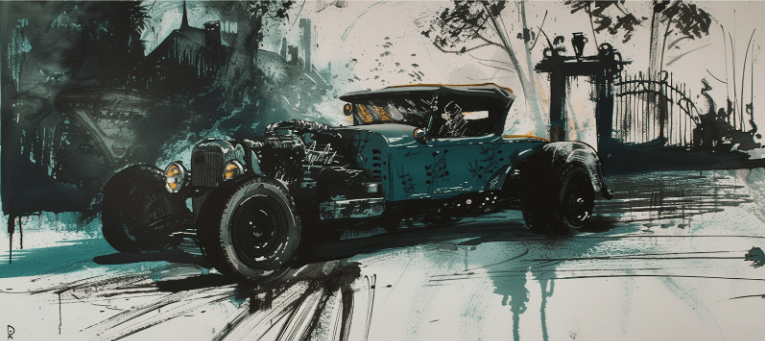
We followed him into his garage, where he kept his collection of hot-rodded 1932 Ford Model 18s, which went “zero to sixty in four seconds.” Each car had only two seats, so Hoffenheimer and Rodrigo took one and Wilson and Foster took another. I walked for a half mile until I found an electric scooter rental, which (after I downloaded the app) went zero to fifteen in thirty seconds and never got any faster.
Rodrigo texted me their location: a second home Wilson owned on Venice Beach that he visited when he wanted to get out of the mansion. When I finally arrived, I realized that I had missed out on a dramatic reveal. The rumors were true; Wilson did, indeed, own one of the alpha series flannels, which Rodrigo was holding and ogling helplessly.
“I know there’s an answer!” Wilson exclaimed, deep in the middle of a conversation with Hoffenheimer. “But what is it? Why did you come to me, Wilhiem?”
“Because I think you’re the only person who can help. I didn’t know you really owned this flannel, Brian, and I’m sorry this pest of a journalist asked you about it.” He made a dismissive gesture toward me. “I specifically asked him not to bring it up, but he couldn’t help himself. Fucking vulture.”
I gave a halfhearted thumbs-up.
“But if you really care about the Pendleton name,” Hoffenheimer continued, “and you really care about flannels in general—and I know you do—you’ll help us.”
Wilson shook his head. “This is about money, isn’t it? You want me to buy back the collection from this Irish woman. Tell me you’re joshin’.”
For the first time since I met him, Hoffenheimer became timid. “Ain’t joshin’,” he replied quietly.
Wilson sighed furtively and said nothing. Foster approached him and put her hand on his shoulder.
“Brian,” she pleaded, “Pendleton is a brand for the people. People who work, people who live regular lives. Pendleton is for plumbers, for engineers, hell, even air traffic controllers. Pendleton is for surfers, for musicians, for icons—but it’s not for collectors. It’s not to be used in petty revenge schemes. Those flannels can’t be destroyed. They deserve to feel the warmth of the sun. We need your help.”
Wilson was silent for a few intense moments. “You know something?” he finally asked. “Before my band was called the Beach Boys, we had a different name. Russ Regan made us change it. But we were originally the Pendletones.”
He turned to face Foster. “Help me, Rhonda, will you? I have a checkbook in the top drawer of that cabinet… would you hand it to me?”
Foster dutifully retrieved it and handed it to Wilson, who put it in his back pocket. “I like spending money,” he declared, “and I like having a good time. We’re going to Ireland.”
Unfortunately, my editor refused to grant me the funds to buy another plane ticket to Ireland. Fortunately, Brian Wilson paid for an overnight cargo ship to take one of his Model 18s to Dublin, and I was able to hide in the car’s cabin and get to Ireland for free. During the sea voyage, I called Rodrigo to see how he was feeling about the situation.
He shared that he was beginning to feel like he was totally out of control. “I mean, isn’t the flannel authenticated at this point?” he asked. “I just don’t know what this has to do with me or my shirt anymore. I think I’m just being used as bait.”
He was right on all counts, but he notably never asked to stay in America or sit out on any of the adventures thus far. “I guess I just don’t have a very… eventful life, you know? I sit at home, I work, I go to Whole Foods to buy nutritional yeast… finally, something is happening to me. Rhonda is really nice, and you can’t help but like Wilhiem. I spend so much time alone, and now something exciting is happening to me. With other people. I just don’t want to miss out.”
I could relate; I was, after all, in the middle of the Atlantic Ocean, sitting inside Brian Wilson’s little deuce coupe, which was inside a shipping container on a high-speed cargo ship that had left Los Angeles only a few hours earlier. It all seemed a little improbable, not to mention impractical.
Yet it was all happening. I thought back to the moment my editor told me about a vintage clothing enthusiast and garment investigator he wanted me to follow. I wondered at the time whether there was enough of a story to warrant a substantial article. If only I had known.
Rodrigo also told me that Hoffenheimer had been on the phone for almost the whole flight, maniacally planning something and speaking in Gaelic and Japanese. We had no idea what he had up his sleeve, and no idea whether or not he could save the flannels. All Rodrigo could tell me for sure was that Hoffenheimer had convinced Wilson to lend him his own alpha series flannel; his idea to bait the Baroness with two newly discovered flannels was coming to fruition.
Everybody was waiting for me, and more importantly, Wilson’s Model 18, at the Dublin port. I crawled out of the car and collapsed on the floor from the near-debilitating back pain that I developed while spending 14 hours in a chop-topped antique car. Foster gave me an Advil, then she and Rodrigo picked me up and deposited me into the backseat of Hoffenheimer’s rental, where I spent the two-hour ride to O’Kildaire’s castle moaning in pain.
We finally arrived, with Wilson in his hot rod right behind us. I managed to get out of the car and stand upright.
“We have about a half hour before Lancaster gets here,” Hoffenheimer told us as we gathered around him. He said something in Gaelic into a walkie-talkie, which responded in kind. “Reinforcements are on the other side of that knoll.” He pointed toward a knoll.
“Now, listen closely,” he continued, “I told the Baroness that I’d be coming with some associates to deliver two more alpha-series flannels to her collection. She doesn’t know who exactly you all are—let’s keep it that way. Lancaster should arrive shortly. He doesn’t know that we’ll be here, and we’re all going to have to play it cool when he arrives. So no neurotic babbling.” He glared in my direction, and Brian Wilson, who had just had an Edible Arrangement delivered, threw a grape at me.
Hoffenheimer plucked a cantaloupe ball off a stick and hurled it at me before continuing. “The Baroness believes that I will add the two alpha flannels to her collection and in doing so humiliate Lancaster. What she doesn’t know is that we’ll stop her before she has the chance to destroy them. By any means necessary.”
I asked what he meant by that, and how he actually intended to stop her.
“Through diplomacy,” he replied, with performative enthusiasm. “By reasoning with her! By putting ourselves out there and hoping for the best!” His theatrical facade of hope dropped into a deep scowl. “Through force if we need to use it. We have reinforcements.” He gazed again at the distant knoll.
I asked more directly who these reinforcements were, and Hoffenheimer just smirked.
Foster broke the silence. “Just some violent vigilantes he knows, no big deal.”
Hoffenheimer scoffed. “It’s the goddamn Irish Republican Brotherhood, Rhonda. They’re not vigilantes, they’re anti-imperialists. And they haven’t had steady gigs for a while now, so they were easy to get. Who do you suggest? The Ulster Defence Association?”
Foster was appalled. “So you’re calling me a loyalist now?”
“If the shoe fits. Anyway,” he continued, ignoring Foster, “the IRB has been instructed to surround the building once Lancaster enters it. When he does, O’Kildaire will humiliate him by revealing the three undocumented alpha flannels. Then she plans to destroy them. Each display case that holds a flannel is rigged to burst into flames when the Baroness flicks a switch in the display room. The IRB will stop her before she gets there.”
“Then what?” Rodrigo asked. “You’re not going to kill her, are you?”
“We’ll make her an offer she can’t refuse,” Hoffenheimer said, referencing a line Marlon Brando uttered in Francis Ford Coppola’s 1972 cinematic masterpiece The Godfather. “Or should I say, our friend Brian will make her an offer she can’t refuse.”
Wilson, leaning against his car, threw a strawberry into the air and caught it in his mouth. “You don’t think working with this, uh, Irish Republican Brotherhood or whoever is gonna be bad for my image, do you?” he asked.
“I wouldn’t worry about it,” Hoffenheimer said.
“Cool. I’m supposed to record a single with Nick Jonas next week and I think he’s Protestant. If he hears about this I just hope he’s not upset.”
Hoffenheimer looked at his watch. “Let’s head in,” he said. He took the lead, picking up the two suitcases that held the flannels, and approached the huge castle doors. They slowly opened with a loud sustained creak, and Baroness Bridgette O’Kildaire herself stood in the entrance to greet us. Her colossal wig towered above the whole group.
“Wilhiem!” she proclaimed in a thick Irish accent, “so good of you to return to provide your services!” A disingenuous yellow smile crept across her wrinkled face.
“I’d never miss the opportunity to help a woman in need,” Hoffenheimer replied.
The Baroness was somehow imposing despite her short stature; she was no more than five feet tall, (not including her massive wig) but she had packed at least six feet of unpleasantness into her hunched frame. “You have the flannels, I presume?” she asked Hoffenheimer, the word ‘flannels’ slipping out of her withered mouth like a diseased hagfish leaving its burrow.
“Of course,” Hoffenheimer replied.
“And who are your acquaintances?”
“This is my secretary Rhonda,” he said as he pointed at Foster, who glared at him. “This is Rodrigo, owner of one of the flannels. And this is Brian Wilson.” He never introduced or made any reference to me, presumably because he trusted in my dedication to remain, as any good journalist should be in a situation like this, utterly nondescript.
The Baroness crept up to Rodrigo with startling agility. “I believe we’ve spoken on the phone, no?”
“Maybe,” Rodrigo whispered nervously.
“And I believe I spoke to your assistant, Mr. Wilson. I’ve been trying to get in touch with you for several months now.”
Wilson shrugged nonchalantly and took a bite out of a flower-shaped pineapple slice. “Maybe.”
The Baroness scowled at him for a few intense moments, they pivoted back to Hoffenheimer. “Show me the flannels,” she ordered.
“Let’s head to the display room, perhaps?”
“Very well.”
We followed her as she moved through the labyrinthine corridors of the castle. Hoffenheimer had given me a roll of Brian Wilson promotional stickers in advance, and I had been tasked with following the group and placing one on the wall every few feet so the Irish Republican Brotherhood would know how to get to the display room.
When we arrived, Foster and Rodrigo’s jaws nearly dropped. Nine alpha series flannels were stored on gold-plated mannequin torsos, each in a beautifully framed display case. Every flannel was unique and strikingly beautiful, containing colors and patterns I had never seen before. The inexplicable power of each shirt radiated from each case; the room almost seemed to be filled with a fog of colorful wool threads, challenging our perceptions and leaving me questioning what was possible from an article of clothing.
Two cases with unclothed mannequins stood in the leftmost part of the room, and Hoffenheimer approached them deliberately. He opened his suitcases, gingerly removed each flannel, and dressed each mannequin. The Baroness approached and laughed gleefully.
“So beautiful. A pity they’ll have to burn.”
Foster flinched, and looked as though she was about to say something, but was interrupted by the sound of someone entering the room.
We turned around to see Edmund Lancaster. He was a short, balding old man with elfish ears and a pretentious pair of gold glasses perched precariously on his nose.
“I didn’t know we’d be having company, my dear,” he told the Baroness as he scanned the room. “Hello, Wilhiem. I just saw your mother, she says that you ought to call her more.”
Hoffenheimer’s fists clenched and he cast a withering look upon the elderly curator. He didn’t respond to the remark.
“You two know each other?” the Baroness asked.
“We run in the same circles,” Lancaster replied, “but Wilhiem here is something of a dilettante.”
“Well,” Hoffenheimer says, “my record says otherwise, doesn’t it? And I believe that today I have the good fortune of proving you wrong—Baroness, would you like to show Edmund your new acquisitions?”
She cackled loudly. “This room,” she proclaimed, “was designed to be a symbol of our everlasting love, was it not?”
“And it is, my dearest!” Lancaster exclaimed.
“Is it?” She asked, her words dripping with spite. “Take a look over here, Edmund. I’ve come across some interesting new pieces.”
Lancaster eyed Rodrigo’s and Wilson’s flannels. “I’m afraid, my love, you’ve come across some forgeries. You know that I already found all the alpha series flannels, of course!”
Hoffenheimer took a thick stack of papers out of his briefcase and pushed them into Lancaster’s chest. “Take a look at these, you philandering, pompous prig.”
Lancaster reviewed the documents—first, Brian Wilson’s certificate of authenticity and note of sale from Sotheby’s, then the documents Hoffenheimer and Rodrigo had spent the past months gathering; the carbon-dating, the A.I. analysis, and finally the flannel’s whole provenance.
“There must be a mistake here,” Lancaster muttered, becoming flustered. He looked up at Wilson. “You denied that you even owned this flannel for years. In every interview you denied it. This must be a forgery!”
Wilson took a bite of a crinkle-cut honeydew wedge. “I guess I just don’t like journalists,” he said, then threw the rest of the slice at me.
“And you!” Lancaster said, turning toward Hoffenheimer, “you think you’ve accomplished something here? You think this will ever get out? I will discredit you to hell and back in the next issue of Wool Clothes Quarterly. You’ll never work in this industry again, I promise you that, you—”
“Shut up!” the Baroness interrupted. “You’re a fraud in this industry! Your greatest achievement has been disproven!”
Lancaster dropped the papers, which scattered all over the floor. “Darling, where is this coming from? I don’t understand—”
“I know what you’ve done!” she exclaimed. “You thought I wouldn’t find out about your affair?”
“My affair?”
“Yes, Edmund, your affair!”
“She means nothing to me, darling! Just a wench I ran into at a conference!”
Hoffenheimer kicked him in the shin. “Scumbag!” he shouted.
Lancaster, for what it was worth, seemed unbothered and even amused by Hoffenheimer’s attack, but turned his attention back toward the Baroness. “We can talk about this, my dear!”
“I’m going to destroy everything you love!” she screamed, heading toward the lightswitch that would ignite the flannels.
Hoffenheimer took the walkie-talkie out of his pocket, turned it on, and yelled something in Gaelic.
Had this been an episode of a high-stakes TV drama, directors would have cut to a commercial at this pivotal moment. Since these events took place in real life, I humbly ask the reader to pause here. I suggest you take a bathroom break, or maybe brew yourself a cup of tea to accommodate the need for a buildup of dramatic tension.
The Baroness hobbled over to the button, but twelve members of the Irish Republic Brotherhood charged into the room and took her by surprise. Two members, dressed in vintage military jackets and boots, effortlessly tackled the decrepit old woman and pinned her to the ground. Her wig flew off her head and rolled into a dusty corner.
“Looks like she’s goin’ bald,” Brian Wilson snickered.
Two more IRB members ran to the switch and stood guard by it, and two more stood by Lancaster. The remaining six, who had anticipated a greater challenge, ambled around aimlessly.
The Baroness shrieked. “What’s going on here?”
“You thought I was going to let you destroy these flannels?” Hoffenheimer asked indignantly. Foster approached and knelt next to the incapacitated Baroness.
“You were never going to get away with this,” she told her. “These are heirlooms, O’Kildaire. Real pieces of clothing that are meant to be worn by real people. You don’t have the right to destroy them.”
“You can’t take them away from me!” the Baroness screamed.
“No,” Wilson said, “but we can buy them.”
“This collection cost me millions,” she said, her wigless head shaking with anger, “you could never afford it!”
“Do you even know who I am? I’m Brian Wilson! I can afford to do whatever I want!”
“I’ll never sell to you!”
Wilson gave a small nod to one of the IRB members, who pushed the muzzle of his gun into the geriatric Baroness’ forehead. Wilson made an offer, and after some minor haggling she accepted. He asked me not to disclose just how much he spent, but later admitted to me that in order to cover the expense he had to allow Metro Boomin to sample ‘Good Vibrations’ on a beat he was producing for Future.
The IRB members led the Baroness out of the room. She was later charged with eleven counts of ‘Conspiracy to Destroy a Culturally Significant Piece of Clothing.’
Lancaster looked distraught as the IRB dragged O’Kildaire out, but quickly regained his composure. “Well played, Whilhiem,” he said, “but if you think you’ll still have a career after this, you’re mistaken. Nobody will believe that three more alpha series flannels have resurfaced— not after I slander you in the press.”
“Oh really?” Hoffenheimer asked. “What if I told you that the press was already here?”
I beamed with pride and stepped forward, ready to be acknowledged by a room full of people who had so far not looked at or spoken to me, but my moment in the spotlight was interrupted by a member of the IRB who stood in front of me.
“Clark Johnson,” he said, pulling a digital recorder out of his pocket, “star undercover reporter for Wool Clothes Quarterly. Do you have any comments for the magazine?”
I stepped back, crestfallen. Lancaster, who was already pale, grew even paler. “No. No comment.”
Rodrigo was shaking with excitement. “I don’t believe Clark Johnson is here,” he told me, “he’s my favorite writer!”
I shrugged and told him that I wasn’t familiar with his work.
The next day everybody flew to Zurich, where Hoffenheimer held a press conference at the European Museum of Outerwear. Afterward, Clark Johnson hosted a sold-out interview and Q&A session with Rodrigo and Hoffenheimer in the museum’s atrium. Before the event ended, surprise guest Brian Wilson came out and performed a medley of his biggest hits from the past year—including his collaboration with Billie Eilish, ‘I Was Made for These Times,’ and a sneak preview of a yet-to-be-released song with Jack Harlow, ‘I LOVE VAGINA (Stop Doubtin’ It.)’
I, of course, only caught the very end of these festivities, as I hadn’t been included in the travel plans. I once again had to stow away in Wilson’s car, which he shipped to France on a ferry he had been able to charter at the last minute. He didn’t trust me to get the car to Zurich myself, so he hired a driver to pick it up and deliver it (and me) to the museum. The driver was a Pole named Jacek, and when I tried to make conversation with him he pointed a gun at me. I don’t think he spoke English.
Jacek was unfortunately arrested when we tried to cross the border into Switzerland, as he was wanted for multiple murders. I had no choice but to drive the car to the museum myself.
Wilson seemed disappointed to see me after the event. “What are you doing here? Where’s Jacek?”
Not wanting to admit that he was in the custody of the Swiss government and that I had driven his car, I told him that Jacek had left in a hurry to make another appointment, but sent his regards.
“Bummer. I was hoping you’d have gotten to know him a little better.”
Clark Johnson’s story ran in the next issue of Wool Clothes Quarterly, which came out a week and a half later. You probably read it already. I didn’t think it really captured the full spectrum of the events that took place, but it nevertheless made significant waves in the vintage flannel community. My editor was outraged that another journalist had written a piece on the story he had entrusted me with, even though Johnson’s story was rather flat and couldn’t be compared to the procedural human-interest angle I had taken.
My editor insisted that I dig deeper and follow up with my sources, so I conducted some post-interviews. Rodrigo and Foster returned to Portland, and a few weeks after the story ran in Wool Clothes Quarterly they went on a single date—but, as Foster told me, “the chemistry just wasn’t there.” She is currently working on starting a watchdog organization to monitor vintage clothing museums and collectors and hold them responsible for their behaviors.
Rodrigo dipped his toes back into collecting but found that things just weren’t the same after helping to take down the Baroness. He has begun sorting through his large collection of clothes and donating items he doesn’t wear.
Brian Wilson refused to get in touch with me for a follow-up interview but was kind enough to mail Shrieks and Whispers a box of dried cow dung. He is reportedly converting one of his Los Angeles homes into a nonprofit Pendleton museum, where he plans to put the garments he bought from Baroness O’Kildaire on public display.
Hoffenheimer immediately moved on to his next project. He had been hired by the Sturbridge Show to vett clothing dealers and had already uncovered multiple instances of fake Levi 501s being peddled by dishonest salespeople. Going over my notes and drafts, I noticed one major unresolved issue, so I called him to ask about any relationship there might be between his mother and Edmund Lancaster.
“Why would you even ask me that question?” he snapped. “They’ve never met.”
In fact, during the altercation at O’Kildaire’s castle, Lancaster had specifically mentioned Hoffenheimer’s mother. I couldn’t help but wonder what that was all about.
After some prodding on my part and some grumbling on his, Hoffenheimer finally admitted the truth. “Fine. You figured it out. My mother is seeing Edmund Lancaster. Are you happy now?”
I was, in fact, pretty happy to have uncovered a vital part of the story that Clark Johnson had overlooked. Another victory for thoughtful, in-depth journalism.
“I’ve always hated that snooty bastard,” Hoffenheimer continued, “and I knew that he and my mother were seeing each other before I found out he had a relationship with the Baroness. So yes, maybe I had some extra motivation to discredit him. And before you ask, yes, they are still together, and yes, it definitely bothers me. So there you go. Hope you feel good about yourself, you nosy fucking prick.”
He hung up, and as the call ended, so too did my triumphant investigation.
The world of vintage clothing collection is a baffling place—in what other sector could a small-time collector find himself allied with a Beach Boy against a corrupt, vengeful Irishwoman? Rodrigo’s flannel was woven, not just out of wool, but also out of fibers of perpetuity and retribution; fibers that intertwine with the threads of history to knit people into the vibrant game that Hoffenheimer and Lancaster play. The threads inevitably fray; collecting, which should be a hobby, becomes all-consuming. It begins leading us to all sorts of confusion and danger—and for what? To verify that a shirt is genuinely as old as you think it is? What difference does it make?
To those who care, it makes a rather significant difference indeed. Maybe they can’t articulate that difference—I certainly can’t—but whatever it is, it lead them from Portland to Zurich to Dublin to Los Angeles and back to Dublin, all in the course of a week. Whatever it is, it swept up Brian Wilson and the Irish Republican Brotherhood in its wake. Whatever it is, as seemingly insignificant as it may seem to you or me, it is life-defining for some subset of people.
When I asked Rodrigo why exactly he had been so invested in authenticating the and if, in the end it had all been worth it, he paused for a long time before responding.
“As for why I did it? I suppose I just wanted to know for certain that it was real. It’s not often in life that you get to know something for certain, and now I know. I’m proud to say that I own an original alpha series Pendleton. And I went on a big adventure and met lots of people in order to find that out, and if that doesn’t make it all worth it, I don’t know what could.”
 Shrieks & Whispers
Leave a comment