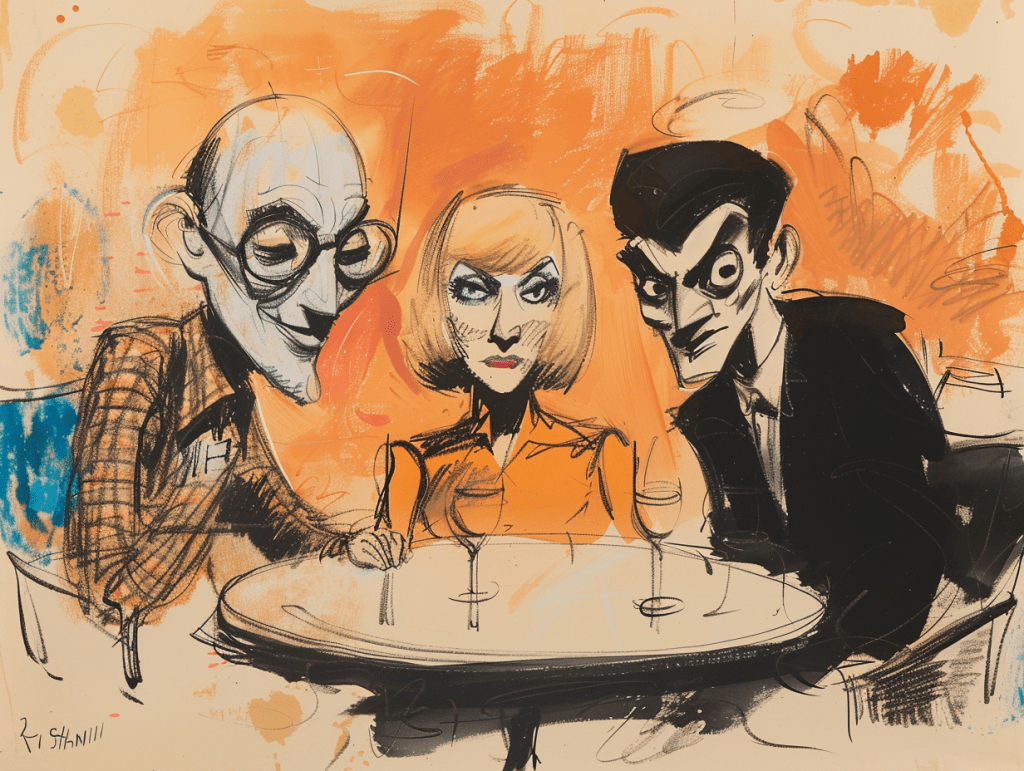
When I got back to Portland, I met Rhonda Foster, in the same cafe that she approached Rodrigo over a year and a half earlier. When I asked her to tell me about the encounter, her story matched, sans the flirting.
“I’m not saying that the flannel should be returned to my family or anything like that,” she said, “but I sure as hell believe that they should belong to, you know, regular people. Working-class people. Not sold for millions of dollars to European elites, or sold to museums.”
Foster claimed that her grandfather—supposedly the favored son of ‘Great-Grampa Pendleton’—owned at least half of the original twelve alpha series flannels, and she remembered seeing them in his closet as a child.
“He was proud to own them,” Foster said, “but it wasn’t, like, a weird fetishistic, over-reverent thing, like people think about them today. They were just really good pieces of clothing and they probably reminded him of his dad.”
She said that she was shocked to see one of her grandfather’s old flannels on Rodrigo. “I saw him in the cafe and I thought, oh my god! My grandpa used to bring me up to the bedroom closet and show that shirt to me, and say ‘these were made by your great-grandfather, these are the flannels that the family business is based on!’”
Foster said that she really just wanted to let Rodrigo know how happy she was to see that he was actually wearing the flannel, since the only others that she knew of were on display in museums or private collections. “But there was also an element of me going, you know, you better not sell that!” she said.
I asked her if she knew what happened to any of the other flannels her grandfather owned. “Toward the end of his life, I know he sold a few. They were just starting to get valuable, I think he sold them to some European collectors. But some of them, he gave away, especially to workers.”
That tracked with the information available on her grandfather, Steve Pendleon Jr. He was a worker’s rights advocate in the 70s and 80s, and handed out Pendleton blankets to members of the Professional Air Traffic Controller’s Organization during their famous 1981 strike. After President Reagan fired them all, he hired a dozen of them to direct loads of wool in and out of Pendleton’s factories.
I asked her if she had ever heard the name Howie Rosenbaum, and she furrowed her brow. “Yeah… he was the family’s landscaper or something. Or electrician? Some kind of service worker. He was around a lot, for some reason. You know, I think my grandpa gave him one or two of the original flannels.”
“One or two.” When I let Hoffenheimer read the transcript of my interview with Foster, those were the words he latched onto. “One or two. If there were two, there could have been one more alpha series flannel in Roseanbaum’s collection. One that the reseller kept, and presumably resold.”
He never thanked me for my in-depth investigative work that saved him the trouble of directly linking Thomas L. Pendleton to a random dead plumber that nobody knew, but I’d like to believe that he showed his appreciation in other ways, like playfully forgetting my name—or later, at a hotel bar, when he bought a round of drinks for everybody but me, all in good fun.
Through a connection at Graild, Hoffenheimer gained access to the elder-abusing reseller’s sales history, identified the other alpha series flannel, and discovered that bidding had ended at a mere $200.
“And get this,” he told me later, his excitement practically radiating through the phone, “Graild is supposed to keep people’s shipping information private, right? Well guess how good I am? I got the name and address! Some guy living in Seattle who had no idea what he had gotten his hands on. So I reached out to him to ask him about the flannel. He told me that just last week, he had gotten a phone call from an old Irish woman” (here he paused for dramatic effect) “who offered him a thousand bucks for it. So of course he accepts the offer. And he shared the address with me. Turns out the flannel was shipped to a castle in Ireland, to…” (here he again paused) “…Baroness Bridgette O’Kildaire! The very same woman who bought up those flannels from the museum! What do you think about that? How good am I?”
Another clue pointing toward the mysterious Irish woman who had bought the European Museum of Outerwear’s alpha flannels. Hoffenheimer believed, probably correctly, that she was also the very same woman who had called Rodrigo.
This, I could tell, was what Hoffenheimer lived for. Garment authentication wasn’t an easy job, and unless you have a personality like his, rarely rewarding. But it seemed to be what he had been put on the earth for; he caught onto leads and chased them to their ends, sometimes fruitlessly, always ruthlessly.
We both tried separately to get in touch with Baroness Bridgette O’Kildaire with no luck. He told me that the only thing to do, at that point, was to go to Ireland and confront her directly. Rodrigo briefly questioned the wisdom of his plan, but Hoffenheimer insisted that it was time to take action. Everything, he told Rodrigo, would come together very soon.
Before the trip to Ireland, he insisted on meeting Rhonda Foster, the great-grandaughter of Thomas L. Pendleton, to grill her about any helpful details about her childhood and the alpha series flannels. Rodrigo wanted to see her again, too, so with her permission I put them all in touch and they arranged to meet and review all the available information.
I was late to this meeting because on the drive over a Portland bike delivery boy hit my rental car with his brakeless single-speed and broke a jar of raw honey on my windshield, which required a whole tank of wiper fluid to get off.
When I arrived, Foster was in a poor mood. Hoffenheimer had told her about the Irish baroness who had been collecting so many of her family’s flannels, and she was livid.
“So what, this woman has a bunch of my great-grandpa’s clothes just displayed around her castle? Like suits of armor?”
“More than a bunch,” Hoffenheimer said, “possibly all authenticated alpha series flannels.” He had called around to every museum that had one in their collection, and they had all been purchased in the last year. After he prodded, he had gotten most curators to admit that Baroness O’Kildaire had been the buyer, and even in the few cases where the curator wouldn’t admit it, he felt it was safe to assume. Every private collector he knew of who owned one had also sold theirs.
Of the twelve original alpha series, he believed that one had been destroyed by Woolrich and one was in the private collection of flannel connoisseur and notorious Beach Boy Brian Wilson. Baroness O’Kildaire owned the eight that Edmund Lancaster had decreed part of the official catalog. Howie Rosenbaum had owned two unrecognized by Lancaster, both of which were acquired by the now-incarcerated Grailed reseller; one now belonged to our very own Rodrigo, and the other had found its way into Baroness O’Kildaire’s collection.
This final flannel was the fulcrum upon which Hoffenheimer’s plan swung. He intended to approach Baroness O’Kildaire at her Irish castle, offering to authenticate the flannel, and in doing so investigate her collection and “get to the bottom of what she was doing.”
It struck me that the whole operation seemed to be expanding outside of its bounds. In his mission to simply authenticate a garment, Hoffenheimer had uncovered some kind of greater scheme, the implications of which nobody could quite grasp. The trip to Ireland was more about confronting Baroness O’Kildaire about her collection, which seemed to have little to do with authenticating the garment. Hoffenheimer had already documented the provenance of Rodrigo’s flannel; it was woven by Thomas L. Pendleton, passed on to his son, Steve, who gave it to Rosenbaum, who was elder-abused by a reseller who sold it to Rodrigo. He had carbon dating and artificial intelligence test results to support its veracity. The job was done.
This fact, which seemed obvious, didn’t occur to the group. The absurdity of the notion that O’Kildaire would be open to the idea of Hoffenheimer knocking on her door and authenticating a flannel that she had bought in secret was lost on them; the group had been swept up in the narrative of their story and the idea that they were playing a role in it.
Rhonda Foster was fueled by righteous outrage at the fact that family heirlooms—historical symbols of the working class that she and generations of her family served and loved for years—had been gathered up by a European collector who treated the workwear as a display piece, fetishized for elite appreciation.
Rodrigo was caught up in the glamor of the item itself, in the idea that the clothing that he’d found meant something about him. In the vintage clothing community, finding a rare and valuable piece is seen as a reflection of a thrifter’s eye for value. The ability to spot a Pendleton on a rack among a sea of Old Navy, Wrangler, and Amazon Essentials garments is a skill that demonstrates your mettle—and to find an alpha series in a dead plumber’s collection? A more reliable sign of your value in the world there could not be. And to help uncover some kind of corruption in the process? What could be more exciting?
And Wilhiem Hoffenheimer, somehow, cared the most of all; he had been hired to authenticate a garment, but the task had fallen to his second priority, obscured by the romantic notion of getting to the bottom of something—which was, I was coming to learn, his base desire in life. That he, Rodrigo, and Foster were losing sight of the original goal was insignificant. As the mystery grew, so too did the appeal.
It was decided that we had to go to Ireland at our earliest convenience.
Due to Shrieks and Whisper’s budget constraints, I was unable to fly with them or stay in The Westbury, their five-star Dublin hotel. I had layovers in Newark and Reykjavik that totaled 20 hours and I rented a room outside of the city, which, unbeknownst to me, was a floor above a chapter of the Men’s Late-Night Shanty Singing Group and a floor below an Irish dancing school that offered early-morning classes to busy professionals.
I met the trio in the lobby of the Westbury early in the morning—Hoffenheimer was there alone when I walked in. His plan was to rent a car and drive out the Baroness O’Kildaire’s castle alone so he could confront her. He’d report back after, and let Rodrigo and Foster know what they could do to help.
After he left, we sat in the hotel lobby. I couldn’t help but wonder why Rodrigo and Foster needed to come on this trip; the operation seemed to be fueled more by a dramatic idea than pragmatism.
Exhausted and bored, I told Rodrigo to text me if Hoffenheimer called, and I walked aimlessly for a while. I followed Leopold Bloom’s day trip through Dublin, which I thought might help me understand Ulysses if I ever tried to read it. Hours passed with no word from Hoffenheimer. I wandered into a bazaar and lingered at a porcelain vase stall. Finally, Hoffenheimer called. He asked me to meet him in the Westbury hotel lobby in forty minutes, and I agreed. Five minutes later, Rodrigo texted me.
‘Hoffenheimer just called. Wants to meet in the Westbury hotel lobby in thirty-five minutes.’ I let him know that I had received a similar message from him and would be on the way soon.
Hoffenheimer told us that he had knocked on the door of O’Kildaire’s castle, and after ten minutes was greeted by her doorman. He was assumed to be some kind of door-to-door fraudster, but with a bit of sweet-talking and explanation, he weaseled himself into a meeting with the Baroness, an encounter that he had to wait over two hours for.
He had never seen anything like her castle; the walls were lined with beautiful displays of vintage items. Hoffenheimer said that the room he had been assigned to wait in was lined with mannequins sporting beaded jazz-era dresses, all of which, to his trained eye, seemed genuine.
He finally met the Baroness, “who was definitely wearing a wig,” in her study, which reportedly held an oversized china display case filled with lucite handbags. He marveled aloud at her impressive collection, and, in his words, “subtly and expertly shifted the conversation to flannels.”
He mentioned, in an “offhand but lightly probing way,” that as a professional authenticator, he had a “gentleman’s interest” in Pendleton’s alpha series, but had never been lucky enough to see one outside of a museum. At this remark, the Baroness’ eyes lit up with interest, but she declined to mention her own collection.
Hoffenheimer shifted the conversation to jewelry and mentioned his recent discovery of his acquaintance’s fake Jager LeCoultre. She shared that she secretly doubted the provenance of a vintage Blancpain diving watch that a suitor of hers wore on beach trips.
Hoffenheimer, disguising his surprise at the fact that such an “old, mean-spirited harridan of a woman with her stupid wig” could ever have a suitor, offered to take a look if he ever had the opportunity. He made this offer with a “knowing chuckle.”
After an hour of similar talk, Hoffenheimer let the conversation lull into a pause “woven with the colors of implication.” She finally mentioned that she had recently acquired an item that he might be interested in taking a look at; an unauthenticated piece of outerwear that she could use a second opinion on.
He played it “cooler than the other side of the pillow” and said that he might have a few minutes to check it out. She stressed the importance of the item and made him swear to secrecy, which Hoffenheimer “cooly but enthusiastically” agreed to.
The Baroness led him through labyrinthine hallways and into a locked room, where, as Hoffenheimer expected, all eight of the confirmed alpha series flannels were displayed. Each, as he reported, was encased in a humidity-controlled lit glass box and displayed on a gold-plated mannequin torso, and each was “exquisitely beautiful.” In the corner was a ninth box, which remained unlit, that displayed the unauthenticated flannel from Rosenbaum’s collection. O’Kildaire asked if he thought it was genuine.
“And of course,” Hoffenheimer said, “It was the real deal. No question about it.” He didn’t reveal this to the Baroness; he told her “without a tremor” that it looked pretty good, but considering how believable forgeries had become lately, it would have to undergo some scientific testing before he could deliver a true verdict.
At this comment, the Baroness “threw back her big ugly bewigged head” and laughed. She told him that she knew intuitively that it was real, but for complex reasons hadn’t sent it on for analysis. The aforementioned suitor with the possibly fake Blancpain had made it his life’s work to document and collect every alpha series flannel, was immensely proud of having discovered eight, and had already publicly declared that all remaining flannels had been found. Another one surfacing, she said, would be tremendously embarrassing for him.
Rodrigo’s jaw dropped. “Wait. Was she talking about Edmund Lancaster? You’re saying that Edmund Lancaster is romantically involved with this woman?”
“Was romantically involved,” Hoffenheimer corrected. “It turns out that the Baroness is a woman scorned. Lancaster had an affair.”
“With whom?” Foster asked.
“I don’t know. Probably not important. But it makes sense to me. Only Edmund Lancaster could ever love a creature as vile as her, but even he, wretched as he is, was bound to stray. He probably got sick of looking at her huge, hideous wig. Bet hell hath no fury that that of the Baroness. As it turns out, she and Lancaster were buying up all the alpha flannels as a symbol of their love and unity, but the collection is not to last.”
The Baroness had a devious plan: she was going to reveal the last flannel and publicly humiliate Lancaster. Then she would reveal that she knew about his affair, and to destroy his sense of self-worth, burn every flannel.
Rodrigo and Foster were livid, but Hoffenheimer assured them that he had a plan.
I asked why, exactly, the Baroness was willing to share all this information with a perfect stranger. What prompted this woman, who had thus far been shrouded in mystery, to lay out her plans to him so clearly?
“Well, I had something to offer her. If she thought one extra alpha flannel was enough to humiliate her disloyal lover… wouldn’t more flannels be exponentially more painful for him?”
“What?” Rodrigo nearly screamed. “You’re going to give her my flannel?”
“Not to destroy, but as a sort of bait. I’m proposing a kind of sting operation.”
“Are you fucking nuts?”
“I got us this far, didn’t I? Have I failed yet?” He tensed up, glaring at Rodrigo. “Have I? Has anything gone less than perfectly?”
“Well, I guess not.”
“You don’t need to guess. It has gone perfectly. And that’s not going to stop now. I have a plan.”
“Okay. Anything to save those flannels, I guess.” A quiet stress settled over the group.
“I wonder who he had an affair with,” Foster wondered aloud. “Do you think she fits into this at all?”
“I doubt it,” Hoffenheimer replied. “And let me tell you this: it definitely wasn’t my mother.”
We all paused.
“Why… uh… why would we… think that?” she asked.
“You would never think that. I’m just ruling it out as a possibility right off the bat.”
“Okay… was that ever, like, something plausible? Was that something that we needed to disprove?”
“No!” Hoffenheimer snapped. “That’s what I’m saying. I’m saying that Edmund Lancaster is definitely not sleeping with my mother. That would be absurd. That would never happen. That’s all I’m saying.”
“Okay. Okay.”
“Anyway, if we’re going to do this, we need some outside support. I can’t privately fund this, but I might know somebody who can. In this industry, there are two types of people: heroes and villains. And I think I know just the hero. We’ll just make a quick detour to Los Angeles.”
 Shrieks & Whispers
Leave a comment